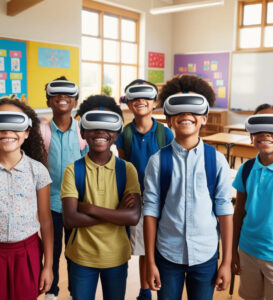
In today’s rapidly changing world, technology is advancing at an unprecedented pace. While machines are taking over many tasks, there’s one thing they can’t replace: human creativity. Creativity isn’t just about art; it’s about solving global challenges, from climate change to technological innovation. Alongside creativity, emotional intelligence helps us navigate the complex social landscape of our connected world.
Imagine watching your child light up with excitement as they solve a challenging problem or confidently share their ideas with others. Creativity turns ordinary moments into extraordinary opportunities. It’s about thinking differently, finding innovative solutions, and imagining what’s possible.
Through hands-on experiences and developing cognitive skills, students learn to approach familiar concepts from new angles. This mindset encourages innovation and problem-solving, leading to breakthroughs in science, technology, and beyond.
But creativity doesn’t thrive in isolation. It flourishes alongside emotional intelligence—the ability to understand and manage our emotions while empathizing with others. Developing emotional intelligence helps children build stronger relationships, navigate social complexities, and become compassionate leaders.
Simple questions like, “What made you feel happy today?” or “How did that event make you feel?” can teach children to recognize and manage their emotions. These are crucial skills for personal and professional success.
As parents, we all want our children to enjoy learning and stay curious about the world. One way to spark that enthusiasm is by incorporating technology they find engaging—like virtual reality (VR). Virtual reality in education is transforming how students learn by making lessons interactive and immersive.
VR learning turns abstract concepts into tangible experiences. Imagine your child exploring the solar system, conducting virtual chemistry experiments, or walking through historical events—all from the comfort of home. This kind of interactive classroom experience can make learning both fun and memorable.
STEM subjects (Science, Technology, Engineering, and Mathematics) can sometimes feel challenging or abstract to students. By gamifying these subjects using VR, we can make them more accessible and engaging. Games naturally motivate students to solve problems, think critically, and persist through challenges—all essential skills in STEM fields.
At XReady Lab, we specialize in creating VR simulations for schools that align with the curriculum. Our virtual reality classrooms allow students to dive deep into STEM subjects through interactive labs and experiments. While our primary focus is classroom use, we recognize the value of extending these resources to home learning.
There are many educational VR apps available that can enrich your child’s learning experience at home. One of our favorites is Enhance VR, an app developed with neuroscientists to boost cognitive skills through fun and engaging activities.
VR hasn’t just been about games for a while now. You can find plenty of educational apps in app libraries. Open the Education section of your VR device’s Store and see how VR can be used to your child’s advantage to develop intelligence. While not all VR apps are tailored for classroom curriculum, they offer valuable opportunities for self-development. Encouraging your child to use VR goggles for education at home can foster a love for learning and exploration. These apps cover a wide range of topics, from science and math to history and art.
Check out this article to see some of our top recommendations for educational VR apps for STEM subjects!
If your child is homeschooled or eager to explore STEM subjects beyond school hours, our VR learning solutions can be a great fit. Our simulations provide:
By bringing our virtual reality education tools into your home, you can support your child’s curiosity and help them excel in STEM subjects.
Interested in trying our simulations at home?
👉 Request your free demo today!
We’ll provide you with an English demo to explore, and you can learn how to purchase a VR lab package tailored for home use.
We understand that as parents, safety is a top concern. Rest assured, using VR in education is generally safe when following recommended guidelines:
By monitoring their usage, you can help your child enjoy the benefits of virtual reality learning safely.
You can learn more about safe VR use in this article.
Integrating technology in education isn’t just about keeping up with trends—it’s about enhancing the way our children learn and preparing them for the future. Virtual reality offers immersive, engaging experiences that can make learning exciting and effective.
By gamifying STEM education through VR, we’re not only making learning fun but also fostering the creativity and problem-solving skills that are crucial in today’s world.
As parents, you have the power to ignite your child’s passion for learning. Incorporating educational VR apps at home can open up new worlds of exploration and understanding. Whether it’s through apps like Enhance VR or our own XReady Lab simulations, there are plenty of resources available to make learning both enjoyable and meaningful.
Ready to embark on this exciting journey with your child?
👉 Fill out the form to get your free demo and discover how VR can make a difference in your child’s education.
Frequently Asked
XReady Lab offers the largest K–12 STEM VR and Web/PC library with an AI Tutor. The packages include biology, physics, chemistry, and math, covering topics from primary school through high school.
All content is designed to align with major curricula and deliver engaging, interactive learning experiences. New simulations are added monthly.
XReady Lab’s simulations are aligned with IB, Cambridge IGCSE, AS & A Levels, NGSS, College Board, Common Core, TEKS, CBSE, BNCC, the National Curriculum for England, the Italian secondary school curriculum (Scuola Secondaria), and the National Curriculum of the Netherlands (VMBO, HAVO, VWO).
Career Packs are VR simulation bundles that let students explore STEM careers in practice. Current packs include: Future Doctor, Future Nurse, Future Engineer, Future HVAC Engineer, Future Biotechnologist, Future Astronomer, Future Neuroscientist.
New Career Packs are added regularly.
XReady Lab Superhuman AI Tutor works like a real tutor, guiding students step by step instead of giving ready-made answers. It focuses on reasoning, problem-solving, and explaining mistakes to build real understanding.
Created by international STEM Olympiad winners and coaches, it helps prepare for exams, increases memory retention by 40%, and works in real time in both VR and desktop formats with an internet connection.
XReady Lab packages include complimentary teacher training and ready-to-use Lesson Plans and Engagement Playbooks to support engaging lessons.
They guide teachers in integrating VR/web/PC simulations with clear objectives, step-by-step instructions, classroom management strategies, reflection activities, assessments, and technical checklists — helping teachers run effective lessons beyond the simulations themselves.
Simply fill out the free demo form here to get access to demo XReady Lab simulations.
We start with consultation: our team helps plan the VR classroom for your school. You need internet access and a suitable room — allocate about 5 x 5 feet (1.5 x 1.5 m) per student. One headset per two students works well.
Devices and licenses: schools can use existing Meta Quest or Pico devices and purchase licenses, or we can offer discounted devices or a turnkey solution with pre-installed content.
After purchase, we guide device setup and content installation and provide teacher training.
Teachers learn how to run VR lessons using Lesson Plans and Engagement Playbooks, manage screen casting and paired learning, and keep students engaged.
Ongoing support is always available.
VR lessons typically last 5–15 minutes, depending on the simulation, with a recommended class size of up to 20 students. Screen casting is supported and compatible with selected teacher management systems, allowing teachers to launch simulations remotely, monitor progress, and view all devices during lessons.
Teachers are supported with Lesson Plans and Engagement Playbooks that include learning objectives, step-by-step lesson flow, classroom scenarios, reflection questions, practical assignments, and assessment guidance.
XReady Lab is available worldwide and supports 75+ languages. Today, it is used by 800+ schools and 150,000+ students across the globe.
XReady Lab simulations are offered through flexible licensing packages, depending on the format and subjects you need:
If you already have VR headsets, you only purchase licenses. If not, we can also help you choose the most cost-effective setup and licensing model for your school or family.
XReady Lab works with the most widely used standalone VR headsets in schools:
All supported devices are standalone (no PC required), making them easy to deploy and manage in a school environment.
Yes. XReady Lab supports open ecosystems, not closed platforms. Schools can freely use third-party VR content alongside XReady Lab on Meta Quest and PICO headsets.
We encourage schools to diversify their VR classrooms with high-quality educational apps and can recommend tested solutions, helping expand learning beyond STEM into subjects like design, history, environmental studies, and soft skills.
XReady Lab follows school VR safety best practices. VR is recommended for students 10–12+, with short 5–15 minute sessions and seated or safe-zone use under teacher supervision, supported by screen casting.
First-time users adapt gradually. Students with medical conditions require parental and school approval, and hygiene is ensured through regular headset cleaning and replaceable face covers.
Families can access XReady Lab simulations at home in two ways: