When we think about virtual reality in education, our minds often drift toward biology simulations—like exploring a plant cell in 3D—or immersive lessons on cell division, such as VR Mitosis. Yet, VR physics also stands as a powerful contender, offering students a chance to dive into complex topics like optics in ways never before possible. From understanding diffraction patterns to mastering the laws of reflection and refraction, VR brings abstract concepts to life through hands-on interaction and real-time feedback.
Traditional physics instruction relies heavily on physical equipment—lenses, prisms, diffraction gratings, and more. Setting up these experiments can be time-consuming, and cleaning up afterward eats into valuable class time. Educators know the struggle of balancing lesson plans with workshop preparation, often leaving less time for actual teaching and exploration.
VR physics solutions streamline this process:

Optics is a cornerstone of high school physics curricula worldwide, and VR provides dynamic ways to explore this field. Instead of passively observing diagrams or watching the teacher adjust lenses and prisms, students become active participants in experiments aligned with global standards, including:
By meeting these curriculum requirements, VR physics tools ensure that students worldwide receive a consistent and high-quality education in optics.
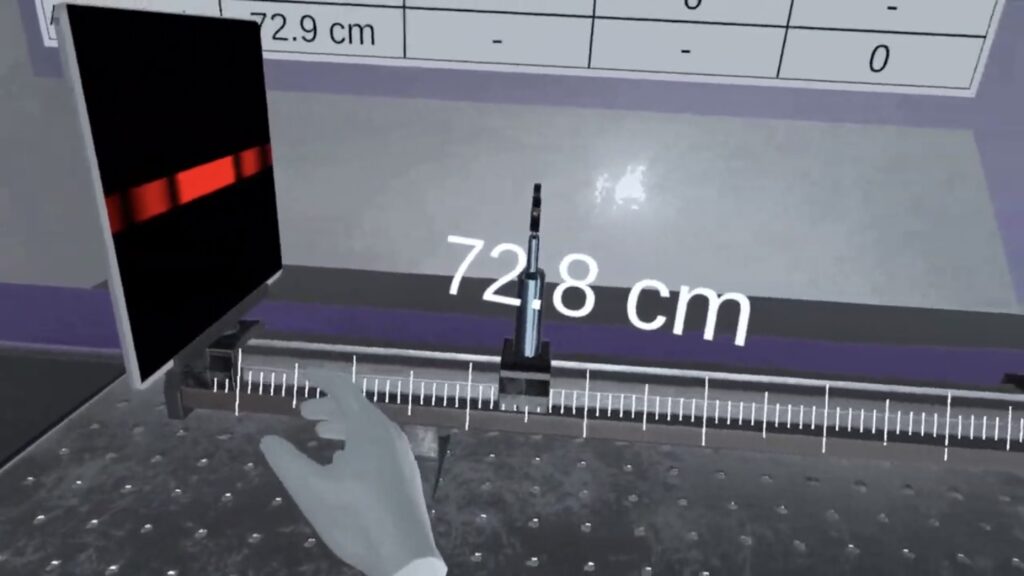
Diffraction is often a challenging concept for students to grasp, as it involves understanding how waves bend and spread out when passing through openings or around obstacles. In a traditional classroom setting, demonstrating diffraction patterns might rely on limited equipment and brief glimpses of results. However, with VR simulations, learners can interact with a laser light source passing through a slit, adjusting parameters like slit width and observing how these changes affect the intensity distribution of the diffraction pattern on a screen.
This hands-on approach transforms abstract wave principles into visual, interactive experiences. Rather than merely memorizing formulas or staring at static diagrams, students gain an intuitive understanding of how the thickness of the bands relates to the gap width. By exploring different configurations in real-time, they foster a deeper grasp of wave behavior that would be difficult to achieve with conventional methods.
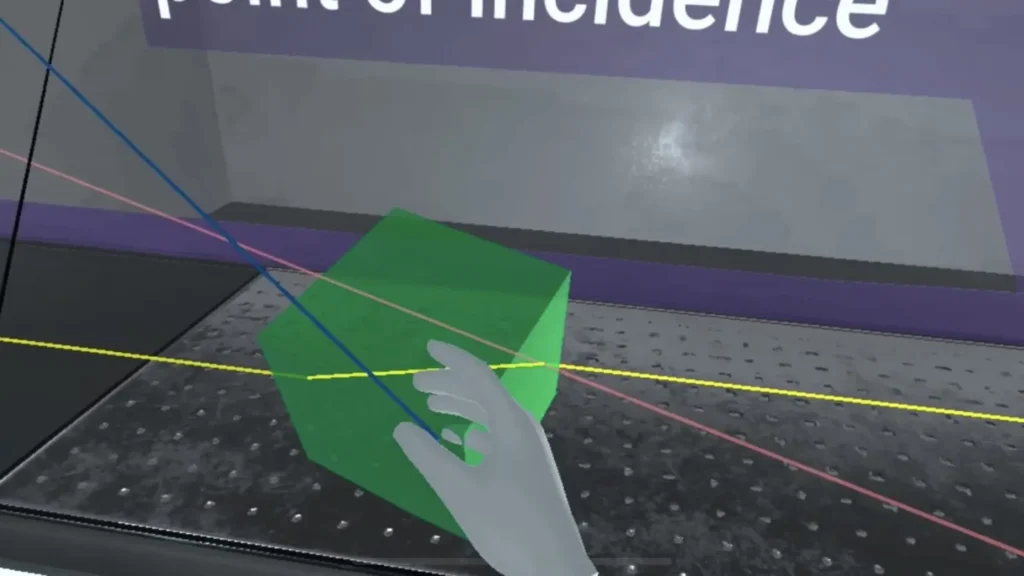
Shining light onto reflective and refractive objects can seem straightforward in theory, but truly understanding how angles of incidence and refraction relate to each other requires more than just reading from a textbook. In a VR physics environment, students can shine light on cubes with reflective and refractive surfaces, measure angles accurately, and see in real time how changes in materials or incident angles influence the path of light.
This direct manipulation offers immediate feedback, helping learners realize how the law of reflection ensures equal angles of incidence and reflection, and how the angle of refraction shifts depending on the medium. Such dynamic visualization solidifies their grasp of core optical principles far more effectively than static illustrations or brief class demonstrations.
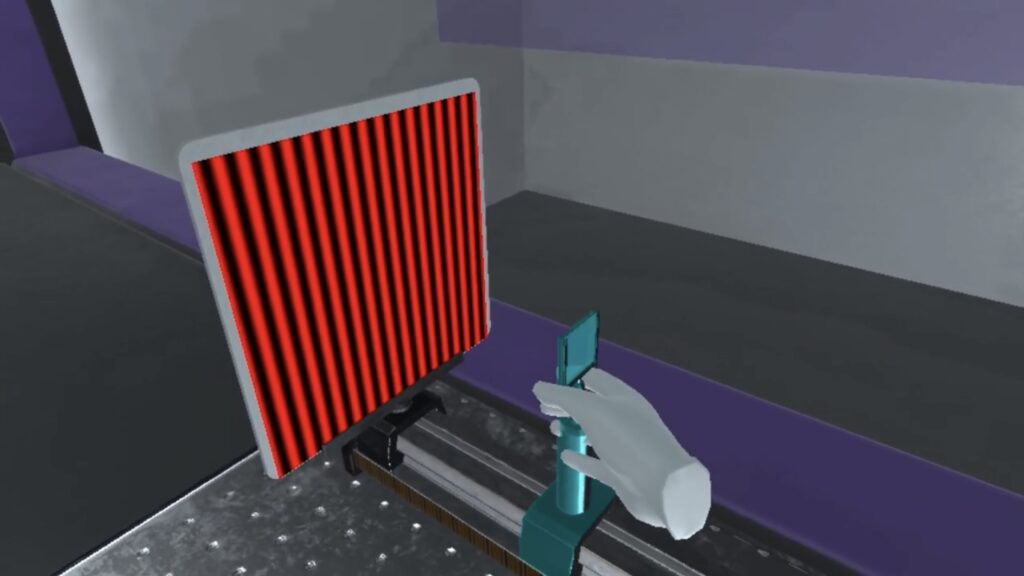
Interference patterns—whether produced by a biprism, double-slit arrangement, or other setups—are notoriously hard to comprehend with traditional teaching methods. Arranging these experiments in a physical lab can be time-consuming and delicate, and observing interference patterns requires precise alignment and stable conditions.
In VR, these issues vanish. Students can easily alter parameters, move the biprism, or adjust distances and observe how interference fringes form and shift. These interactive classroom activities allow learners to witness coherence, wave superposition, and the resulting bright and dark bands that define interference. This level of clarity can be pivotal for mastering concepts that often remain abstract when explained solely through lectures and pictures.
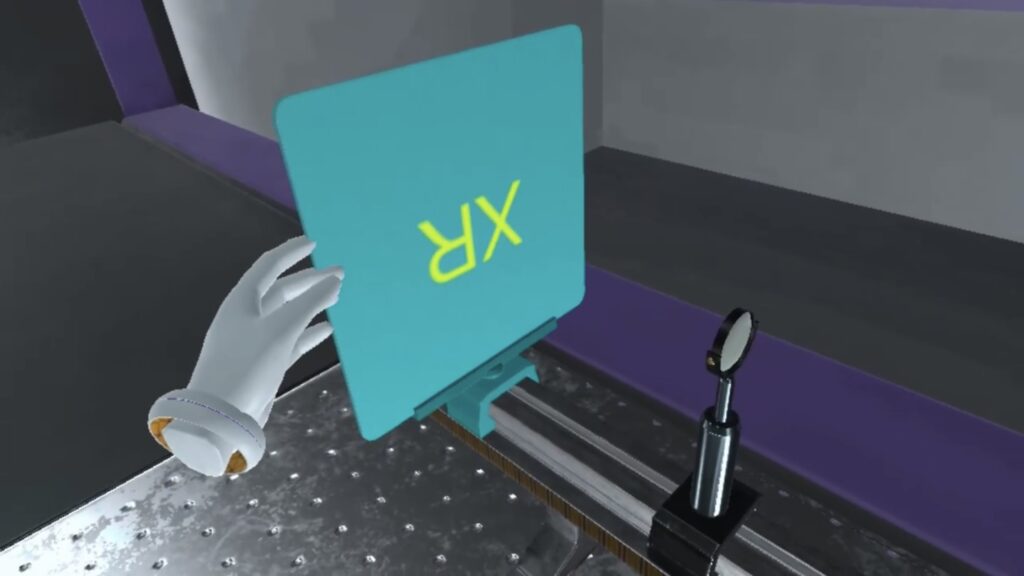
Exploring how lenses form images is essential in optics, but setting up lens experiments, aligning light sources, and ensuring proper measurements can be cumbersome in a physical lab. VR simulations simplify this process dramatically. Students can place converging or diverging lenses, observe image formation on a virtual screen, and measure linear dimensions to determine focal lengths and other lens parameters—all without guesswork or manual recalibration.
The clarity and precision offered by VR reduce confusion and let students focus on the underlying physics. By adjusting lens configurations and instantly seeing the effects, learners develop a more intuitive understanding of how changes in curvature or refractive indices influence image quality and position. Such direct, adaptable exploration supports the mastery of concepts that are often tricky to demonstrate in traditional labs.
By integrating VR into the classroom, teachers and students can shift from passive observation to active participation, fostering a learning environment where exploration and curiosity thrive. If you’re curious about how VR can transform your physics lessons and enhance student engagement, we invite you to experience it firsthand.
While VR physics shines as a transformative tool for teaching optics and other physics concepts, its potential extends well beyond this single domain. VR biology, for example, enables students to delve into the structure of plant cells, as discussed in our VR Plant Cell Exploration article. Likewise, VR Mitosis simulations allow learners to experience cell division firsthand, providing a richer understanding than any static image or brief classroom activity could offer. By incorporating VR learning tools across various STEM fields, educators can keep students engaged, maintain their interest in science and technology, and ultimately improve academic success.
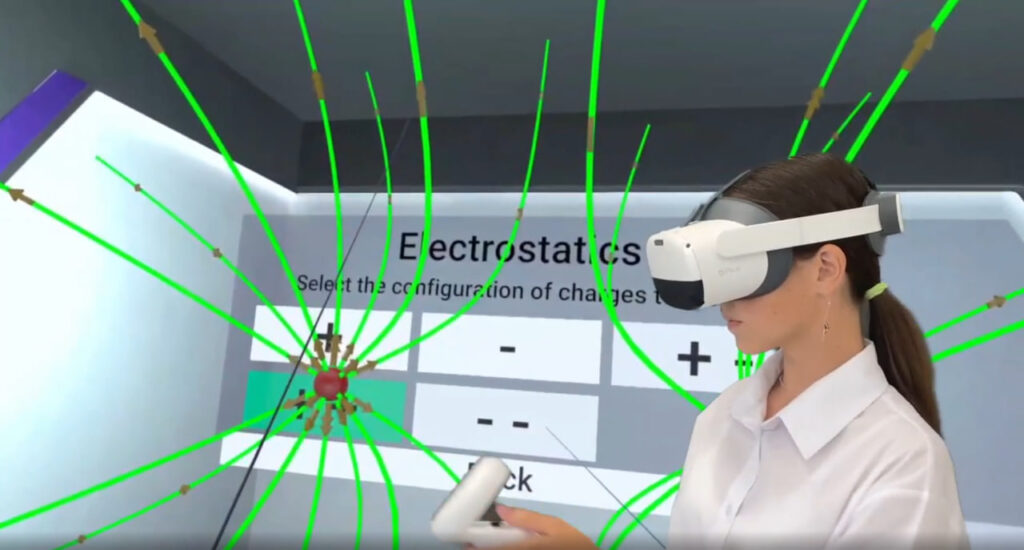
In addition to enriching learning experiences, VR also frees educators from routine, time-consuming tasks. Rather than spending valuable class time setting up and dismantling equipment, teachers can focus on guiding students, answering questions, and deepening conceptual understanding. This shift enables educators to do what they do best—inspire, mentor, and motivate—rather than juggle logistical duties. For further insights on how emerging technologies can streamline classroom management, consider exploring the Top 5 AI Tools for Teachers. While that article highlights AI solutions, the core principle is the same: advanced tools should lessen administrative burdens, empowering teachers to concentrate on meaningful teaching and mentoring.
As students advance through secondary school, their enthusiasm for STEM subjects often wanes, primarily due to the complexity and abstraction of the material. By making lessons interactive, tangible, and genuinely engaging, VR can help rekindle this enthusiasm. Instead of simply learning theories, students can live them out in immersive, virtual worlds, seeing for themselves how scientific principles operate. To understand how VR can help reverse the decline in STEM interest, take a look at our article Why Interest in STEM Declines and How VR Revives It.
By broadening subject matter, reducing educator workload, and increasing student engagement, VR stands as a powerful ally in cultivating a vibrant, future-focused STEM culture in classrooms worldwide.
VR physics: optics represents a quantum leap in how we teach and learn about the behavior of light, lenses, diffraction, and interference. By providing immersive, interactive simulations that align with global curricula, VR technology transforms complex concepts into accessible, hands-on experiences.
Adopting VR in the classroom means less time spent on setup and cleanup, more time for meaningful instruction, and, ultimately, more motivated and successful students. It also empowers teachers to go beyond traditional methods, nurturing curiosity, critical thinking, and a genuine love for STEM subjects.
As education continues to evolve, embracing VR solutions ensures that learning keeps pace with our rapidly changing world—offering students an exciting and engaging path to academic success and lifelong scientific curiosity.
Frequently Asked
XReady Lab offers the largest K–12 STEM VR and Web/PC library with an AI Tutor. The packages include biology, physics, chemistry, and math, covering topics from primary school through high school.
All content is designed to align with major curricula and deliver engaging, interactive learning experiences. New simulations are added monthly.
XReady Lab’s simulations are aligned with IB, Cambridge IGCSE, AS & A Levels, NGSS, College Board, Common Core, TEKS, CBSE, BNCC, the National Curriculum for England, the Italian secondary school curriculum (Scuola Secondaria), and the National Curriculum of the Netherlands (VMBO, HAVO, VWO).
Career Packs are VR simulation bundles that let students explore STEM careers in practice. Current packs include: Future Doctor, Future Nurse, Future Engineer, Future HVAC Engineer, Future Biotechnologist, Future Astronomer, Future Neuroscientist.
New Career Packs are added regularly.
XReady Lab Superhuman AI Tutor works like a real tutor, guiding students step by step instead of giving ready-made answers. It focuses on reasoning, problem-solving, and explaining mistakes to build real understanding.
Created by international STEM Olympiad winners and coaches, it helps prepare for exams, increases memory retention by 40%, and works in real time in both VR and desktop formats with an internet connection.
XReady Lab packages include complimentary teacher training and ready-to-use Lesson Plans and Engagement Playbooks to support engaging lessons.
They guide teachers in integrating VR/web/PC simulations with clear objectives, step-by-step instructions, classroom management strategies, reflection activities, assessments, and technical checklists — helping teachers run effective lessons beyond the simulations themselves.
Simply fill out the free demo form here to get access to demo XReady Lab simulations.
We start with consultation: our team helps plan the VR classroom for your school. You need internet access and a suitable room — allocate about 5 x 5 feet (1.5 x 1.5 m) per student. One headset per two students works well.
Devices and licenses: schools can use existing Meta Quest or Pico devices and purchase licenses, or we can offer discounted devices or a turnkey solution with pre-installed content.
After purchase, we guide device setup and content installation and provide teacher training.
Teachers learn how to run VR lessons using Lesson Plans and Engagement Playbooks, manage screen casting and paired learning, and keep students engaged.
Ongoing support is always available.
VR lessons typically last 5–15 minutes, depending on the simulation, with a recommended class size of up to 20 students. Screen casting is supported and compatible with selected teacher management systems, allowing teachers to launch simulations remotely, monitor progress, and view all devices during lessons.
Teachers are supported with Lesson Plans and Engagement Playbooks that include learning objectives, step-by-step lesson flow, classroom scenarios, reflection questions, practical assignments, and assessment guidance.
XReady Lab is available worldwide and supports 75+ languages. Today, it is used by 800+ schools and 150,000+ students across the globe.
XReady Lab simulations are offered through flexible licensing packages, depending on the format and subjects you need:
If you already have VR headsets, you only purchase licenses. If not, we can also help you choose the most cost-effective setup and licensing model for your school or family.
XReady Lab works with the most widely used standalone VR headsets in schools:
All supported devices are standalone (no PC required), making them easy to deploy and manage in a school environment.
Yes. XReady Lab supports open ecosystems, not closed platforms. Schools can freely use third-party VR content alongside XReady Lab on Meta Quest and PICO headsets.
We encourage schools to diversify their VR classrooms with high-quality educational apps and can recommend tested solutions, helping expand learning beyond STEM into subjects like design, history, environmental studies, and soft skills.
XReady Lab follows school VR safety best practices. VR is recommended for students 10–12+, with short 5–15 minute sessions and seated or safe-zone use under teacher supervision, supported by screen casting.
First-time users adapt gradually. Students with medical conditions require parental and school approval, and hygiene is ensured through regular headset cleaning and replaceable face covers.
Families can access XReady Lab simulations at home in two ways: