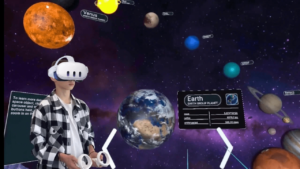
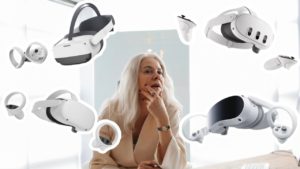
In the rapidly evolving world of technology, two innovations are poised to transform education as we know it: Artificial Intelligence (AI) and Virtual Reality (VR). Individually, they offer powerful tools for enhancing the learning experience. Combined, they hold the promise of creating a supercharged, personalized, and immersive educational environment that caters to each student’s unique needs.
Artificial Intelligence in education is opening doors to personalized learning like never before. AI algorithms function much like a personal tutor, understanding and adapting to each student’s unique learning journey. By analyzing performance data, engagement metrics, and even behavioral cues, AI creates a comprehensive profile for each student.
For instance, in a traditional classroom setting, a teacher may not have the capacity to give individual attention to every, students’ unique learning needs. With AI, the system can identify that a student excels in theoretical comprehension but struggles with practical application. In response, the AI can introduce more hands-on exercises within the VR environment to strengthen practical skills.
While AI focuses on personalization, Virtual Reality in education brings engagement to a whole new level. VR learning transforms traditional lessons into immersive experiences, capturing students’ attention and making learning fun. By integrating game mechanics and interactive storytelling, VR keeps students motivated and enhances retention.
Imagine students exploring the human body in a VR biology class, witnessing chemical reactions firsthand in VR chemistry, or experiencing the laws of motion in VR physics simulations. These experiences are not just about observing—they’re about interacting and experimenting in a safe, controlled environment.
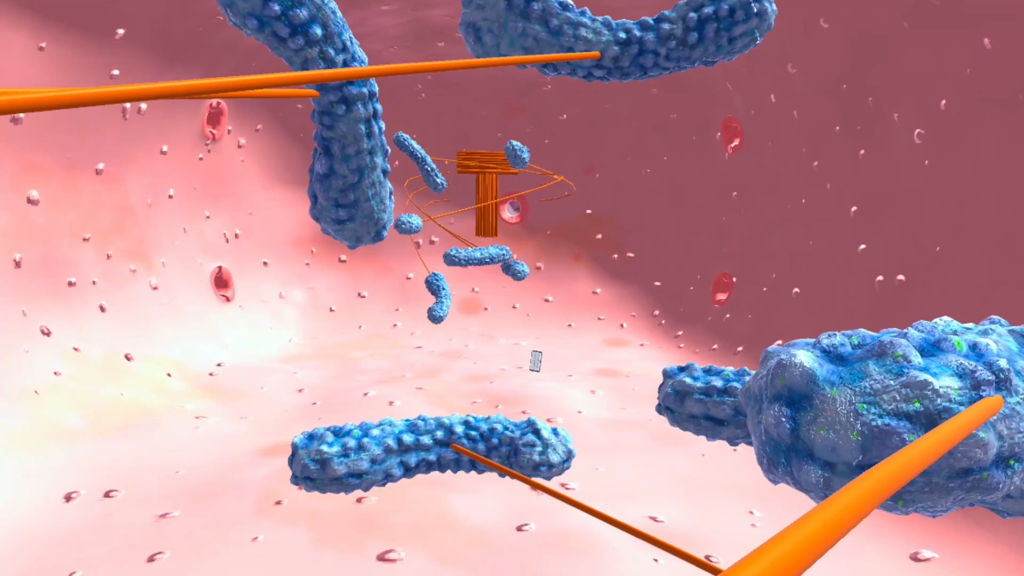
At XReady Lab, we’ve developed VR modules like Mitosis, where students dive inside a cell to understand the process of cell division. This isn’t just a virtual tour; it’s an interactive mission that reinforces learning through participation.
You can try it yourself—Mitosis is included in our free demo package.
👉 Request your free demo here!
For more exciting VR applications in STEM education, check out our expert picks of top VR education apps.
The real magic happens when AI and VR come together in the digital classroom. This combination creates an educational experience that is not only immersive but also dynamically tailored to each. AI acts as the brain within the VR environment, constantly monitoring each student’s interactions, responses, and engagement levels. Itis can in one video game like environment.
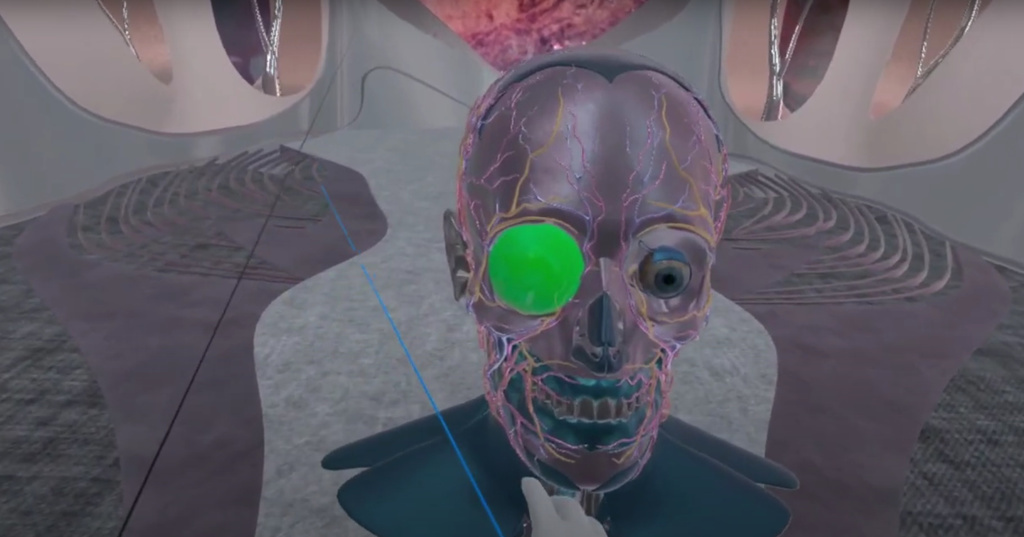
Imagine a student exploring the complexities of the human body through a VR simulation. As they navigate through veins, arteries, and organs, AI algorithms analyze their actions and comprehension in real-time. If the AI detects that the student is spending extra time examining the heart but quickly moves through the lungs, itinwithout highlighting the lungs again, the system mightwith the heart, providing additional information, interactive challenges, or even introducing a virtual tutor to explain concepts in greater detail.
Moreover, thiswon in multiple students’ performances. For example, it,comprehend a particular topic, the AI can alert the teacher, suggesting a review session or a different teaching approach. This ensures that nonever falls behind or becomes disengaged.
The fusion of AI and VR also allows for a more inclusive learning environment. For students with learning disabilities or special educational needs, AI can modify the VR content to accommodate their requirements, ensuring equal learning opportunities for all students.
At XReady Lab, we’re at the forefront of this educational revolution. Our VR education platform creates immersive learning experiences that engage students and enhance understanding. We offer a range of VR learning solutions that are:
Our focus on VR in the classroom has shown significant benefits in student engagement and achievement. By harnessing VR’s immersive capabilities, we’re helping schools create smart classrooms that prepare students for the future. We believe that the integration of AI and VR is an exciting direction for the future of education, offering the potential for even more personalized and dynamic learning experiences. While we currently specialize in VR technology, we are committed to staying at the forefront of educational innovation and exploring how advancements like AI can further enhance learning.
The integration of AI and VR is more than just a technological advancement; it’s a shift towards a more effective and inclusive educational system. As we continue to develop these tools, we envision a world where every student has access to personalized, engaging, and high-quality education.
Is virtual reality safe? Absolutely. With proper guidelines and supervision, VR is a safe and powerful tool for learning. We prioritize virtual reality safety to ensure that students have positive experiences.
Ready to transform your educational approach?
👉 Request your free VR demo today!
Experience firsthand how the combination of AI and VR can revolutionize your classroom.
The future of education lies at the intersection of AI and VR. By harnessing the strengths of both technologies, we can create learning environments that are not only effective but also inspiring. At XReady Lab, we’re excited to be part of this journey, providing the tools and support needed to make this vision a reality.
Frequently Asked
XReady Lab offers the largest K–12 STEM VR and Web/PC library with an AI Tutor. The packages include biology, physics, chemistry, and math, covering topics from primary school through high school.
All content is designed to align with major curricula and deliver engaging, interactive learning experiences. New simulations are added monthly.
XReady Lab’s simulations are aligned with IB, Cambridge IGCSE, AS & A Levels, NGSS, College Board, Common Core, TEKS, CBSE, BNCC, the National Curriculum for England, the Italian secondary school curriculum (Scuola Secondaria), and the National Curriculum of the Netherlands (VMBO, HAVO, VWO).
Career Packs are VR simulation bundles that let students explore STEM careers in practice. Current packs include: Future Doctor, Future Nurse, Future Engineer, Future HVAC Engineer, Future Biotechnologist, Future Astronomer, Future Neuroscientist.
New Career Packs are added regularly.
XReady Lab Superhuman AI Tutor works like a real tutor, guiding students step by step instead of giving ready-made answers. It focuses on reasoning, problem-solving, and explaining mistakes to build real understanding.
Created by international STEM Olympiad winners and coaches, it helps prepare for exams, increases memory retention by 40%, and works in real time in both VR and desktop formats with an internet connection.
XReady Lab packages include complimentary teacher training and ready-to-use Lesson Plans and Engagement Playbooks to support engaging lessons.
They guide teachers in integrating VR/web/PC simulations with clear objectives, step-by-step instructions, classroom management strategies, reflection activities, assessments, and technical checklists — helping teachers run effective lessons beyond the simulations themselves.
Simply fill out the free demo form here to get access to demo XReady Lab simulations.
We start with consultation: our team helps plan the VR classroom for your school. You need internet access and a suitable room — allocate about 5 x 5 feet (1.5 x 1.5 m) per student. One headset per two students works well.
Devices and licenses: schools can use existing Meta Quest or Pico devices and purchase licenses, or we can offer discounted devices or a turnkey solution with pre-installed content.
After purchase, we guide device setup and content installation and provide teacher training.
Teachers learn how to run VR lessons using Lesson Plans and Engagement Playbooks, manage screen casting and paired learning, and keep students engaged.
Ongoing support is always available.
VR lessons typically last 5–15 minutes, depending on the simulation, with a recommended class size of up to 20 students. Screen casting is supported and compatible with selected teacher management systems, allowing teachers to launch simulations remotely, monitor progress, and view all devices during lessons.
Teachers are supported with Lesson Plans and Engagement Playbooks that include learning objectives, step-by-step lesson flow, classroom scenarios, reflection questions, practical assignments, and assessment guidance.
XReady Lab is available worldwide and supports 75+ languages. Today, it is used by 800+ schools and 150,000+ students across the globe.
XReady Lab simulations are offered through flexible licensing packages, depending on the format and subjects you need:
If you already have VR headsets, you only purchase licenses. If not, we can also help you choose the most cost-effective setup and licensing model for your school or family.
XReady Lab works with the most widely used standalone VR headsets in schools:
All supported devices are standalone (no PC required), making them easy to deploy and manage in a school environment.
Yes. XReady Lab supports open ecosystems, not closed platforms. Schools can freely use third-party VR content alongside XReady Lab on Meta Quest and PICO headsets.
We encourage schools to diversify their VR classrooms with high-quality educational apps and can recommend tested solutions, helping expand learning beyond STEM into subjects like design, history, environmental studies, and soft skills.
XReady Lab follows school VR safety best practices. VR is recommended for students 10–12+, with short 5–15 minute sessions and seated or safe-zone use under teacher supervision, supported by screen casting.
First-time users adapt gradually. Students with medical conditions require parental and school approval, and hygiene is ensured through regular headset cleaning and replaceable face covers.
Families can access XReady Lab simulations at home in two ways: