The working world is undergoing a seismic shift. Children in school today may be aiming for careers that won’t even exist by the time they graduate, while brand-new roles—beyond anyone’s current imagination—will rise to prominence. Given this uncertainty, it’s essential to look at what truly withstands the test of time: soft skills and deeper meta-skills. One of the most critical soft skills for navigating this rapidly changing landscape is emotional intelligence.
In an era where technical knowledge is quickly outdated and professions vanish or emerge at lightning speed, emotional intelligence (EI) anchors individuals to a versatile skill set that applies across all fields. It involves recognizing your own emotions and understanding those of others, which fosters better communication, conflict resolution, and empathy in any environment—be it an advanced tech startup or a traditional classroom.
Remember: While the education system struggles to adapt to new realities and teach children skills relevant to actual career paths, soft and meta-skills remain essential. Emotional intelligence stands out because it directly impacts teamwork, leadership, creativity, and personal well-being.

Soft Skills are learned, practical abilities—like problem-solving, active listening, or presentation techniques.
Meta-Skills are the underlying personal qualities—like adaptability or resilience—that enable the development of both soft and hard skills.
According to research from the National Soft Skills Association, a staggering 85% of job success depends on strong soft skills and interpersonal abilities, while just 15% is attributed to technical expertise. Yet many organizations dedicate the lion’s share of their training budgets to hard skills. This mismatch highlights the crucial role emotional intelligence, as a core soft skill, plays in professional and personal achievement.
At its core, emotional intelligence includes:
Self-Awareness
Identifying and naming one’s emotions accurately.
Self-Management
Regulating reactions, especially during stressful moments.
Social Awareness
Perceiving and respecting the emotions and perspectives of others.
Relationship Management
Effectively communicating, resolving conflicts, and collaborating with diverse personalities.
When children (or adults) develop these components, they become more adaptable in a fast-changing world—whether they’re working with VR physics simulations or collaborating with colleagues in a digital classroom.
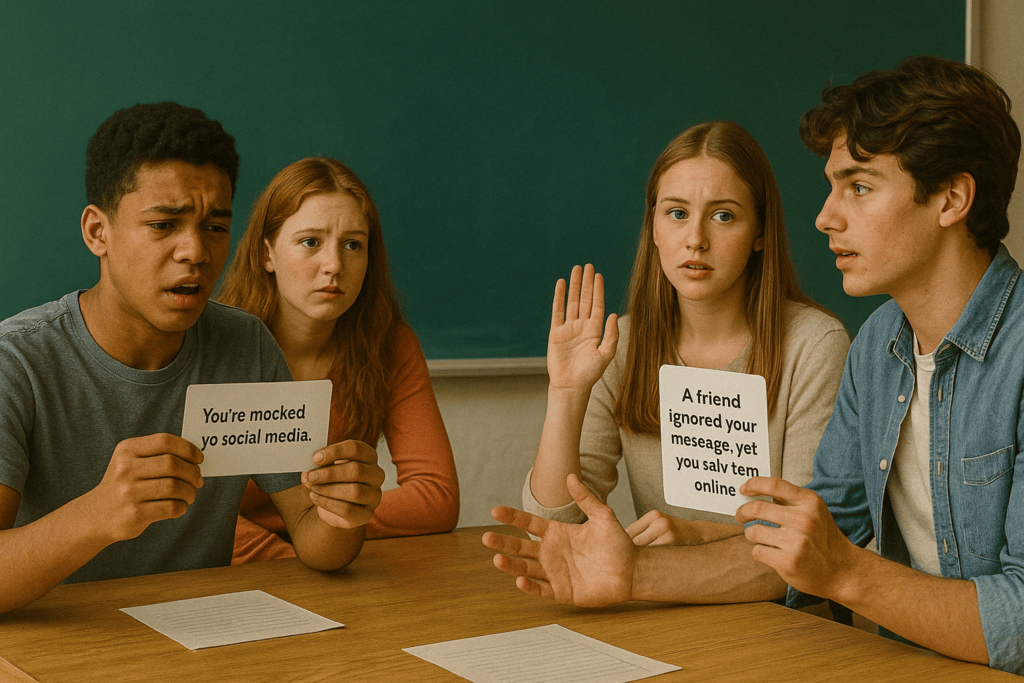
One simple way to nurture emotional intelligence is through interactive classroom activities, woven seamlessly into existing lessons. For example:
Scenario Cards
Distribute cards featuring emotional dilemmas, such as:
“You’re mocked on social media.”
“A friend ignored your message, yet you saw them online.”
Immediate vs. Thoughtful Reactions
First, students share their raw, impulsive responses. Next, they brainstorm calmer, more constructive reactions—almost like building a mental ‘emotional shield.’
Group Discussion
Have participants explore what triggered the emotional reactions and how empathy or clear communication could alter the outcome.
Body Language Insights
Conclude with an exercise where classmates guess each other’s emotions based on posture and facial expressions, reinforcing the idea that emotional cues are key to understanding and connection.
Bonus Tips:
Incorporate such scenarios into a biology or math lesson by creating hypothetical social situations linked to the subject matter—like group work gone wrong or stressful test environments.
Encourage frequent short “emotional check-ins” so students practice identifying and naming their feelings, turning emotional intelligence from a one-off lesson into a daily habit.
While emotional intelligence often focuses on human-to-human connection, modern tools can deepen and enrich this skill development. For instance, immersive modules demonstrate how virtual reality in education can foster empathy. Imagine using VR in the classroom to place students in various cultural contexts or challenging social scenarios, prompting them to recognize and empathize with different emotional perspectives.
Top 5 Cultural VR Labs also illustrate how a VR learning solution can expand students’ worldviews, helping them better grasp emotional nuances across diverse cultures. By seamlessly integrating such platforms into existing curricula, teachers can nurture emotional intelligence without needing a dedicated “empathy class.”

Career Endurance
EI transcends job roles. Even as professions appear and disappear, those with high emotional intelligence remain adaptable, creative, and resilient.
Better Collaboration
Whether it’s a STEM lab or a corporate setting, EI aids in managing teamwork and resolving conflicts effectively.
Superior Leadership
Leaders who read team dynamics accurately can motivate their groups to excel, especially in high-pressure fields like VR physics or AI research.
Personal Growth
Beyond the workplace, people strong in EI often enjoy healthier relationships and reduced stress, leading to overall life satisfaction.
‘Emotion Check’ Warm-Ups: Start each class by having students identify a moment that made them feel a specific emotion—curiosity, frustration, or excitement—and discuss productive ways to handle it.
Science of Emotions: In a biology VR setting, teach the physiological side of emotions (e.g., stress hormones, the fight-or-flight response) to connect emotional awareness with scientific understanding.
Mathematical Empathy: When tackling group math problems, assign roles like “compassionate solver” or “diplomatic mediator.” This fosters an environment where emotional management is as valued as numerical accuracy.
Emotional intelligence isn’t just a buzzword—it’s a powerful soft skill that supports every aspect of learning, working, and thriving in our rapidly changing world. While the education system struggles to keep pace with evolving job markets, EI remains evergreen. It underpins creativity, teamwork, and leadership, ensuring that whatever path students ultimately take—be it a VR chemistry lab or the next big tech startup—they’ll be equipped to handle both the technical and human challenges that come their way.
By weaving emotional intelligence into everyday lessons and leveraging innovative platforms such as VR for education, schools can pave the way for resilient, empathetic learners prepared to navigate a future that, by all predictions, will be anything but predictable.
Frequently Asked
XReady Lab offers the largest K–12 STEM VR and Web/PC library with an AI Tutor. The packages include biology, physics, chemistry, and math, covering topics from primary school through high school.
All content is designed to align with major curricula and deliver engaging, interactive learning experiences. New simulations are added monthly.
XReady Lab’s simulations are aligned with IB, Cambridge IGCSE, AS & A Levels, NGSS, College Board, Common Core, TEKS, CBSE, BNCC, the National Curriculum for England, the Italian secondary school curriculum (Scuola Secondaria), and the National Curriculum of the Netherlands (VMBO, HAVO, VWO).
Career Packs are VR simulation bundles that let students explore STEM careers in practice. Current packs include: Future Doctor, Future Nurse, Future Engineer, Future HVAC Engineer, Future Biotechnologist, Future Astronomer, Future Neuroscientist.
New Career Packs are added regularly.
XReady Lab Superhuman AI Tutor works like a real tutor, guiding students step by step instead of giving ready-made answers. It focuses on reasoning, problem-solving, and explaining mistakes to build real understanding.
Created by international STEM Olympiad winners and coaches, it helps prepare for exams, increases memory retention by 40%, and works in real time in both VR and desktop formats with an internet connection.
XReady Lab packages include complimentary teacher training and ready-to-use Lesson Plans and Engagement Playbooks to support engaging lessons.
They guide teachers in integrating VR/web/PC simulations with clear objectives, step-by-step instructions, classroom management strategies, reflection activities, assessments, and technical checklists — helping teachers run effective lessons beyond the simulations themselves.
Simply fill out the free demo form here to get access to demo XReady Lab simulations.
We start with consultation: our team helps plan the VR classroom for your school. You need internet access and a suitable room — allocate about 5 x 5 feet (1.5 x 1.5 m) per student. One headset per two students works well.
Devices and licenses: schools can use existing Meta Quest or Pico devices and purchase licenses, or we can offer discounted devices or a turnkey solution with pre-installed content.
After purchase, we guide device setup and content installation and provide teacher training.
Teachers learn how to run VR lessons using Lesson Plans and Engagement Playbooks, manage screen casting and paired learning, and keep students engaged.
Ongoing support is always available.
VR lessons typically last 5–15 minutes, depending on the simulation, with a recommended class size of up to 20 students. Screen casting is supported and compatible with selected teacher management systems, allowing teachers to launch simulations remotely, monitor progress, and view all devices during lessons.
Teachers are supported with Lesson Plans and Engagement Playbooks that include learning objectives, step-by-step lesson flow, classroom scenarios, reflection questions, practical assignments, and assessment guidance.
XReady Lab is available worldwide and supports 75+ languages. Today, it is used by 800+ schools and 150,000+ students across the globe.
XReady Lab simulations are offered through flexible licensing packages, depending on the format and subjects you need:
If you already have VR headsets, you only purchase licenses. If not, we can also help you choose the most cost-effective setup and licensing model for your school or family.
XReady Lab works with the most widely used standalone VR headsets in schools:
All supported devices are standalone (no PC required), making them easy to deploy and manage in a school environment.
Yes. XReady Lab supports open ecosystems, not closed platforms. Schools can freely use third-party VR content alongside XReady Lab on Meta Quest and PICO headsets.
We encourage schools to diversify their VR classrooms with high-quality educational apps and can recommend tested solutions, helping expand learning beyond STEM into subjects like design, history, environmental studies, and soft skills.
XReady Lab follows school VR safety best practices. VR is recommended for students 10–12+, with short 5–15 minute sessions and seated or safe-zone use under teacher supervision, supported by screen casting.
First-time users adapt gradually. Students with medical conditions require parental and school approval, and hygiene is ensured through regular headset cleaning and replaceable face covers.
Families can access XReady Lab simulations at home in two ways: