


Q: How can schools prepare students for future STEM careers like biotechnology before they even graduate?
It’s not a far-fetched question anymore. Biotechnology is no longer a distant dream for college graduates in lab coats – it’s a field shaping the 21st century right now. From developing sustainable food to creating life-saving medical innovations, biotechnologists are designing the future of our planet.
So how do we help today’s students step into that future? The answer starts earlier than you might think – right in the classroom.
We often tell kids to “follow their interests” but rarely show them how to do that in a structured, hands-on way. Schools play a crucial role in bridging that gap between curiosity and career readiness.
That’s why XReady Lab has developed career-focused educational packages that help students explore real professions through interactive VR simulations and guided experiments. Each package connects directly to global curriculum standards, so teachers can integrate them seamlessly into existing lesson plans.
And we’re starting with one of the most in-demand, future-shaping professions: biotechnology.
The “Future Biotechnologist” package is more than a set of digital lessons. It’s an immersive educational experience that lets students explore the invisible world of cells and molecules with their own hands.
It includes everything from cell structure and molecular biology to DNA, mitosis, and cellular respiration. Students learn not by watching but by doing – manipulating organelles, building molecules, and performing experiments inside virtual laboratories.
And unlike long videos or static presentations, VR learning in XReady Lab boosts memory retention by up to 40%, thanks to its interactive and immersive format.
Because once you’ve moved a centrosome to the opposite pole during mitosis yourself – you’ll never forget how cell division works.
👉 Try XReady Lab’s Biology Simulations
Each career package comes with:
General implementation guides for smooth curriculum integration
Simulation objectives and topic lists for lesson planning
Engagement playbooks with pre-, during-, and post-lab activities
Teacher training and ready-to-use lesson templates
Assessment materials and troubleshooting checklists
Every simulation is aligned with IB, NGSS, TEKS, Cambridge, College Board, and CBSE standards – making it ideal for both international schools and local programs.
Plant Cell
Explore cell walls, chloroplasts, and vacuoles in 3D.
Learn how each organelle contributes to photosynthesis and structure.
Build analysis and observation skills through guided VR interaction.
Animal Cell
Study membranes, mitochondria, and the Golgi apparatus.
See how cellular systems work together to sustain life.
Strengthen analytical thinking by connecting structure to function.
Bacterial and Fungal Cells
Compare prokaryotic and eukaryotic cells.
Study nucleoid, plasmid, and mesosome structures.
Reinforce understanding of cellular diversity and evolution.
Nucleotide Factory
Visualize how DNA is structured and replicated.
Explore the molecular logic behind genetic information.
Protein Biosynthesis
Go step-by-step through transcription and translation.
See proteins fold and travel through the endoplasmic reticulum and Golgi apparatus.
Reinforce learning by manipulating molecules in real time.
Photosynthesis
Discover light and dark reactions inside the chloroplast.
Follow the energy transfer process involving ATP, NADP+, and CO₂.
Cell Division (Mitosis and Meiosis)
Physically move chromosomes, pull spindle fibers, and observe division stages.
Compare mitosis and meiosis to understand genetic variation.
Master key biological concepts through visual and tactile learning.
Metabolism and Cellular Respiration
Follow the pathway from glycolysis to oxidative phosphorylation.
Assemble molecules in each reaction stage – glycolysis, link reaction, Krebs cycle, and electron transport chain.
Watch ATP formation unfold in a spatially accurate mitochondrion.
Each simulation is more than just a model. It’s a career skill builder: observation, analysis, hypothesis testing, and teamwork all come into play – exactly what biotechnologists do in real labs.
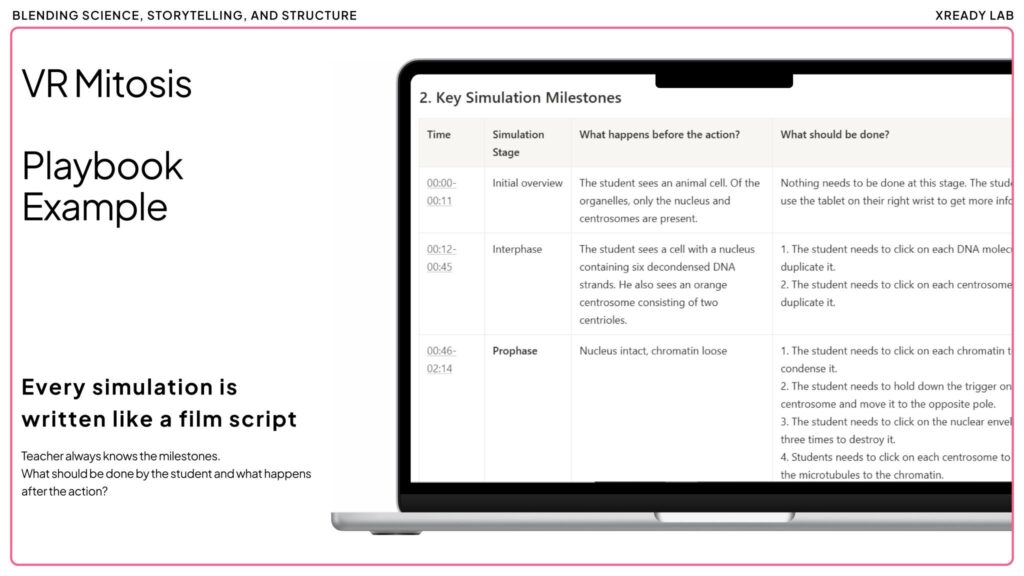
The Future Biotechnologist Playbook includes step-by-step lesson guides that make VR integration easy even for educators new to digital tools.
It breaks the process into:
Before the simulation – organize groups, set learning goals, and assign roles.
During the simulation – guide students through discovery questions and collaborative tasks.
After the simulation – lead reflection, analysis, and assessment discussions.
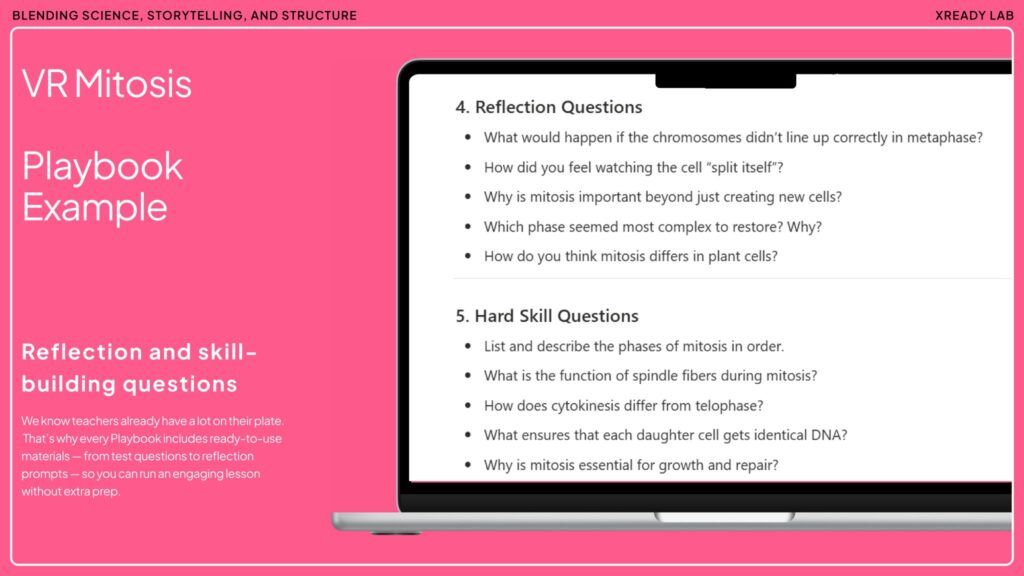
Each lesson plan includes reflection and critical-thinking prompts, like:
“What could go wrong if the DNA replication process stopped halfway?”
“Which organelle would you redesign for efficiency and why?”
For schools, the “Future Biotechnologist” package is not just about technology – it’s about outcomes.
Ready-to-launch lessons aligned with multiple global curricula.
Increased engagement and motivation among students.
Teacher support, training, and troubleshooting included.
No need for expensive equipment or specialized rooms – everything works through accessible VR and web platforms.
👉 Bring XReady Lab to Your Classroom
The world doesn’t need more memorization. It needs more imagination.
Students preparing for tomorrow’s biotechnology careers need to experiment, not just observe. They need to connect theory to the real world through interactive, visual experiences that stay in memory and spark curiosity.
That’s exactly what XReady Lab’s simulations do – they build understanding through motion, exploration, and problem-solving.
And when the time comes for these students to step into real laboratories, they won’t just know the answers. They’ll know how to find them.
The careers of the future won’t be built by rote learning. They’ll be built by students who can see the invisible, think critically, and ask better questions.
With the Future Biotechnologist package, XReady Lab helps schools give that ability to every student – one cell, one experiment, one discovery at a time.
Learn more about bringing the Future Biotechnologist package to your school:
👉 Launch XReady Lab in Classrooms
Frequently Asked
XReady Lab offers the largest K–12 STEM VR and Web/PC library with an AI Tutor. The packages include biology, physics, chemistry, and math, covering topics from primary school through high school.
All content is designed to align with major curricula and deliver engaging, interactive learning experiences. New simulations are added monthly.
XReady Lab’s simulations are aligned with IB, Cambridge IGCSE, AS & A Levels, NGSS, College Board, Common Core, TEKS, CBSE, BNCC, the National Curriculum for England, the Italian secondary school curriculum (Scuola Secondaria), and the National Curriculum of the Netherlands (VMBO, HAVO, VWO).
Career Packs are VR simulation bundles that let students explore STEM careers in practice. Current packs include: Future Doctor, Future Nurse, Future Engineer, Future HVAC Engineer, Future Biotechnologist, Future Astronomer, Future Neuroscientist.
New Career Packs are added regularly.
XReady Lab Superhuman AI Tutor works like a real tutor, guiding students step by step instead of giving ready-made answers. It focuses on reasoning, problem-solving, and explaining mistakes to build real understanding.
Created by international STEM Olympiad winners and coaches, it helps prepare for exams, increases memory retention by 40%, and works in real time in both VR and desktop formats with an internet connection.
XReady Lab packages include complimentary teacher training and ready-to-use Lesson Plans and Engagement Playbooks to support engaging lessons.
They guide teachers in integrating VR/web/PC simulations with clear objectives, step-by-step instructions, classroom management strategies, reflection activities, assessments, and technical checklists — helping teachers run effective lessons beyond the simulations themselves.
Simply fill out the free demo form here to get access to demo XReady Lab simulations.
We start with consultation: our team helps plan the VR classroom for your school. You need internet access and a suitable room — allocate about 5 x 5 feet (1.5 x 1.5 m) per student. One headset per two students works well.
Devices and licenses: schools can use existing Meta Quest or Pico devices and purchase licenses, or we can offer discounted devices or a turnkey solution with pre-installed content.
After purchase, we guide device setup and content installation and provide teacher training.
Teachers learn how to run VR lessons using Lesson Plans and Engagement Playbooks, manage screen casting and paired learning, and keep students engaged.
Ongoing support is always available.
VR lessons typically last 5–15 minutes, depending on the simulation, with a recommended class size of up to 20 students. Screen casting is supported and compatible with selected teacher management systems, allowing teachers to launch simulations remotely, monitor progress, and view all devices during lessons.
Teachers are supported with Lesson Plans and Engagement Playbooks that include learning objectives, step-by-step lesson flow, classroom scenarios, reflection questions, practical assignments, and assessment guidance.
XReady Lab is available worldwide and supports 75+ languages. Today, it is used by 800+ schools and 150,000+ students across the globe.
XReady Lab simulations are offered through flexible licensing packages, depending on the format and subjects you need:
If you already have VR headsets, you only purchase licenses. If not, we can also help you choose the most cost-effective setup and licensing model for your school or family.
XReady Lab works with the most widely used standalone VR headsets in schools:
All supported devices are standalone (no PC required), making them easy to deploy and manage in a school environment.
Yes. XReady Lab supports open ecosystems, not closed platforms. Schools can freely use third-party VR content alongside XReady Lab on Meta Quest and PICO headsets.
We encourage schools to diversify their VR classrooms with high-quality educational apps and can recommend tested solutions, helping expand learning beyond STEM into subjects like design, history, environmental studies, and soft skills.
XReady Lab follows school VR safety best practices. VR is recommended for students 10–12+, with short 5–15 minute sessions and seated or safe-zone use under teacher supervision, supported by screen casting.
First-time users adapt gradually. Students with medical conditions require parental and school approval, and hygiene is ensured through regular headset cleaning and replaceable face covers.
Families can access XReady Lab simulations at home in two ways:
