


A few years ago, asking a child “Who do you want to be when you grow up?” felt harmless. Doctor. Engineer. Teacher. Maybe lawyer.
Today, that question feels oddly outdated.
According to the World Economic Forum, 65 percent of children entering school today will work in jobs that do not yet exist. That number alone changes everything. Not slowly. Immediately.
The old formula
school → university → one lifelong profession
is breaking down in real time.
And the uncomfortable truth is this: professions are changing faster than schools can update curricula, but skills can still keep up. If we focus on the right ones.
This is where the real conversation about future careers should begin.
The labor market is no longer shaped by one breakthrough at a time. It is shaped by several at once.
Artificial intelligence.
Automation.
Virtual and augmented reality.
Robotics.
Biotechnology.
Climate technologies.
Each of these forces alone would be disruptive. Together, they create constant motion.
McKinsey estimates that up to 30 percent of tasks across most occupations can already be automated. Not entire jobs. Tasks. Which means jobs mutate instead of disappearing overnight.
At the same time, PwC and Meta estimate that VR-related technologies could contribute up to $1.5 trillion to the global economy by 2030. This is not a niche anymore. It is infrastructure.
So what survives in such a market?
Not job titles.
Skill systems.
AI is exceptionally good at answers.
It is still bad at judgment.
That is why cognitive skills become more valuable, not less.
These include:
Critical thinking
Scientific literacy
Understanding cause and effect
The ability to question results, not just accept them
OECD data already shows that students with stronger critical thinking skills adapt better to unfamiliar problems, even outside their original field.
In practical terms, this means a student who understands how a process works can switch domains more easily than someone who memorized outcomes.
This is why education must move from “what is the answer?” to “why does this happen?”
Technological literacy in 2025 is not about everyone becoming a programmer.
It is about understanding systems.
AI literacy: knowing what AI can and cannot do
Data literacy: reading, interpreting, and questioning data
VR literacy: learning inside simulations, not just watching explanations
UNESCO’s AI Competency Framework emphasizes that basic AI understanding will be as fundamental as reading and writing.
The same logic applies to immersive technologies. Students who learn inside simulated environments do not just absorb information. They build mental models.
This matters because future jobs will not ask “Can you use this tool?”
They will ask “Can you adapt when the tool changes?”
Ironically, the more advanced technology becomes, the more human skills matter.
Deloitte’s Human Capital Trends consistently highlight growth in demand for:
Communication
Collaboration
Emotional intelligence
Leadership in hybrid teams
Why?
Because machines optimize processes. Humans navigate uncertainty.
Future workplaces will be mixed environments: humans working with AI systems, simulations, and automated workflows. Soft skills become the glue that holds these systems together.
Here is the skill nobody taught explicitly in school for decades: learning how to learn.
In a world where professions change every 5 to 7 years, self-learning is survival.
This includes:
Curiosity
Reflection
Experimentation
Comfort with temporary failure
OECD’s Future of Education and Skills 2030 framework repeatedly emphasizes that adaptability is learned, not inherited.
Students who are allowed to explore, test, and revise their thinking grow into adults who are not paralyzed by change.
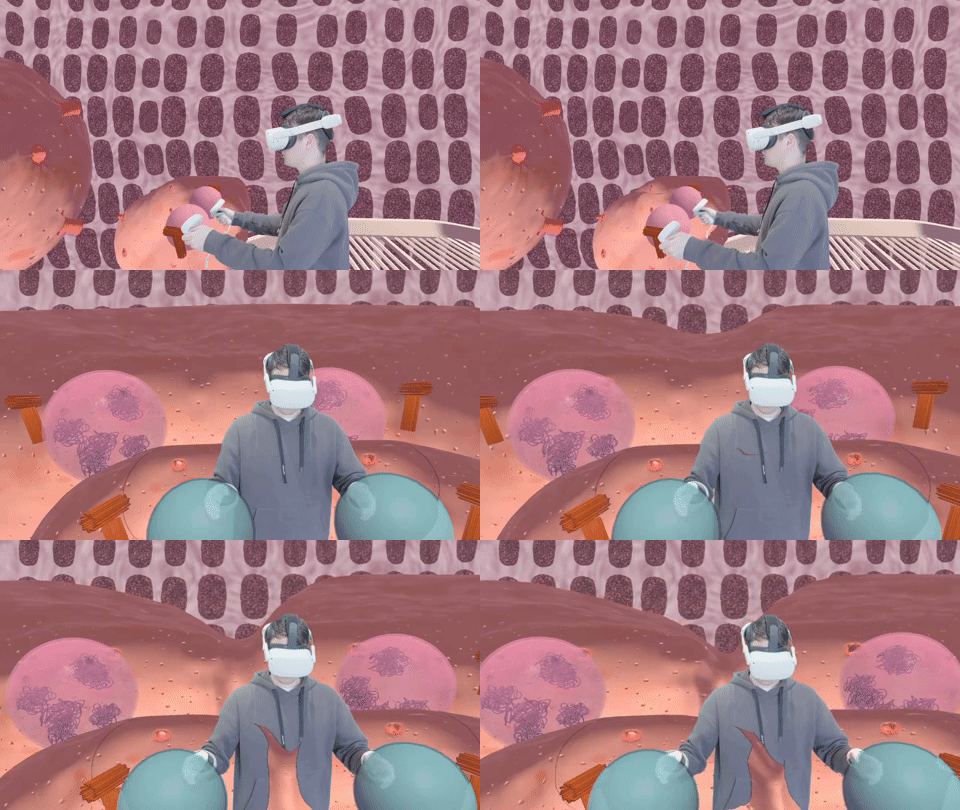
Virtual reality does something traditional education struggles with.
It removes abstraction.
Instead of reading about systems, students enter them.
They see cause and effect in real time
They experiment safely
They fail without social pressure
They repeat until understanding clicks
Research from Stanford’s Virtual Human Interaction Lab shows that immersive learning environments significantly improve conceptual understanding and long-term retention.
VR does not overload students. It organizes complexity visually and spatially, which is exactly how the brain prefers to learn.
If you combine these skills into real tracks, something interesting happens.
You get career packages.
Not rigid professions, but structured skill systems.
Examples already implemented through XReady Lab simulations include:
Future Doctor
Scientific literacy + anatomy + data analysis
Future Engineer
Physics + critical thinking + prototyping
Future Biotechnologist
Biology + chemistry + working with models
Future Radiology Technician
Anatomy + physics + medical technology
Future HVAC Engineer
Thermodynamics + electricity + optics
Each package is not about predicting a single job.
It is about building transferable competence.
By 2030 to 2040, the labor market will look less like a ladder and more like a network.
People will move sideways, diagonally, sometimes backward, then forward again.
Failure will be normal.
Experimentation will be expected.
Relearning will be constant.
In this reality, the mission of schools changes.
Not to protect children from technology.
But to make them naturally fluent in it.
XReady Lab already models this future by turning abstract careers into tangible, skill-based systems inside VR environments. Not as predictions. As preparation.
The most important question is no longer
“What profession should a child choose?”
The better question is
“Which skill systems should they start building now?”
Because job titles will change.
Skills will compound.
And the ability to learn, adapt, and experiment will define success far more than any diploma ever could.
Frequently Asked
XReady Lab offers the largest K–12 STEM VR and Web/PC library with an AI Tutor. The packages include biology, physics, chemistry, and math, covering topics from primary school through high school.
All content is designed to align with major curricula and deliver engaging, interactive learning experiences. New simulations are added monthly.
XReady Lab’s simulations are aligned with IB, Cambridge IGCSE, AS & A Levels, NGSS, College Board, Common Core, TEKS, CBSE, BNCC, the National Curriculum for England, the Italian secondary school curriculum (Scuola Secondaria), and the National Curriculum of the Netherlands (VMBO, HAVO, VWO).
Career Packs are VR simulation bundles that let students explore STEM careers in practice. Current packs include: Future Doctor, Future Nurse, Future Engineer, Future HVAC Engineer, Future Biotechnologist, Future Astronomer, Future Neuroscientist.
New Career Packs are added regularly.
XReady Lab Superhuman AI Tutor works like a real tutor, guiding students step by step instead of giving ready-made answers. It focuses on reasoning, problem-solving, and explaining mistakes to build real understanding.
Created by international STEM Olympiad winners and coaches, it helps prepare for exams, increases memory retention by 40%, and works in real time in both VR and desktop formats with an internet connection.
XReady Lab packages include complimentary teacher training and ready-to-use Lesson Plans and Engagement Playbooks to support engaging lessons.
They guide teachers in integrating VR/web/PC simulations with clear objectives, step-by-step instructions, classroom management strategies, reflection activities, assessments, and technical checklists — helping teachers run effective lessons beyond the simulations themselves.
Simply fill out the free demo form here to get access to demo XReady Lab simulations.
We start with consultation: our team helps plan the VR classroom for your school. You need internet access and a suitable room — allocate about 5 x 5 feet (1.5 x 1.5 m) per student. One headset per two students works well.
Devices and licenses: schools can use existing Meta Quest or Pico devices and purchase licenses, or we can offer discounted devices or a turnkey solution with pre-installed content.
After purchase, we guide device setup and content installation and provide teacher training.
Teachers learn how to run VR lessons using Lesson Plans and Engagement Playbooks, manage screen casting and paired learning, and keep students engaged.
Ongoing support is always available.
VR lessons typically last 5–15 minutes, depending on the simulation, with a recommended class size of up to 20 students. Screen casting is supported and compatible with selected teacher management systems, allowing teachers to launch simulations remotely, monitor progress, and view all devices during lessons.
Teachers are supported with Lesson Plans and Engagement Playbooks that include learning objectives, step-by-step lesson flow, classroom scenarios, reflection questions, practical assignments, and assessment guidance.
XReady Lab is available worldwide and supports 75+ languages. Today, it is used by 800+ schools and 150,000+ students across the globe.
XReady Lab simulations are offered through flexible licensing packages, depending on the format and subjects you need:
If you already have VR headsets, you only purchase licenses. If not, we can also help you choose the most cost-effective setup and licensing model for your school or family.
XReady Lab works with the most widely used standalone VR headsets in schools:
All supported devices are standalone (no PC required), making them easy to deploy and manage in a school environment.
Yes. XReady Lab supports open ecosystems, not closed platforms. Schools can freely use third-party VR content alongside XReady Lab on Meta Quest and PICO headsets.
We encourage schools to diversify their VR classrooms with high-quality educational apps and can recommend tested solutions, helping expand learning beyond STEM into subjects like design, history, environmental studies, and soft skills.
XReady Lab follows school VR safety best practices. VR is recommended for students 10–12+, with short 5–15 minute sessions and seated or safe-zone use under teacher supervision, supported by screen casting.
First-time users adapt gradually. Students with medical conditions require parental and school approval, and hygiene is ensured through regular headset cleaning and replaceable face covers.
Families can access XReady Lab simulations at home in two ways:
