


Q: Can a high school student really start preparing for a neuroscience or psychology career?
Yes. Curiosity about how the mind and body work often starts long before university. The question “why do I think this way?” or “what happens in my brain when I feel happy?” can turn into a real scientific path. And the earlier schools begin to nurture that curiosity, the stronger the foundation for future careers in psychology and neuroscience.
Preparing students for scientific careers means helping them connect biology, chemistry, and human behavior. Schools can do that not with more lectures, but with interactive lessons where students experiment, observe, and draw conclusions.
XReady Lab’s Future Neuroscientist and Psychologist package helps schools achieve this through career-based VR simulations. Students study the brain, hormones, and neurons by actually exploring them inside virtual 3D environments. They don’t just watch a video – they build, interact, and experiment.
This package introduces students to the science of the brain and human behavior. It includes lessons on the nervous and endocrine systems, along with deep dives into cellular processes like synaptic transmission and protein synthesis that explain how thoughts, emotions, and reflexes are formed.
Each simulation helps students understand how the human body and mind communicate on multiple levels – from molecules to whole systems.
All simulations are aligned with IB, NGSS, TEKS, College Board, Cambridge, and CBSE standards, so schools can easily integrate them into their programs.
VR helps students move from memorizing to understanding. They can walk inside a brain, connect neurons, or assemble the human eye layer by layer.
Learning this way makes complex concepts tangible. Research shows that VR improves memory retention by up to 40% compared to passive formats like textbooks or video lessons.
And yes, once you’ve built an eye yourself and added every layer – cornea, lens, pupil – you won’t forget how it works.
👉 Bring Neuroscience to Your Classroom
Each lab comes with detailed teacher materials: simulation objectives, pre-class preparation, group setup, reflection prompts, and troubleshooting checklists. Teachers also receive full playbooks for before, during, and after the simulation.
Here are the key labs included in the Future Neuroscientist and Psychologist package:
Human Brain
Identify the main regions of the brain: cerebrum, cerebellum, and medulla.
Understand how each region manages coordination, movement, and involuntary control.
Explore how the central nervous system processes stimuli and generates responses.
VR Anatomy: Brain
Examine a detailed 3D model of the human brain.
Explore the medulla, pons, cerebellum, midbrain, diencephalon, and cerebral hemispheres.
Understand how brain regions connect reflexes, coordination, and higher thinking.
VR Anatomy: Synapse
Study the structures of chemical and electrical synapses.
Observe neurotransmitter release, synaptic delay, and direct ion flow through gap junctions.
Compare both types of synapses to understand how neurons send and receive information.
VR Anatomy: Endocrine System
Identify the main hormone-producing glands: hypothalamus, pituitary, thyroid, pancreas, adrenal glands, ovaries, and testes.
Learn how these glands regulate metabolism, growth, reproduction, and stress.
Visualize how hormonal balance supports emotional and physical well-being.
VR Anatomy: Human Eye
Build the human eye by assembling each layer in 3D.
Study the sclera, retina, cornea, iris, lens, and ciliary muscles.
Learn how the pupil reacts to light and how the lens adjusts focus for near and distant vision.
Connect structure and function through direct interaction.
Protein Biosynthesis (Neural Protein Production)
Explore the stages of protein biosynthesis: transcription, translation, and packaging in the Golgi apparatus.
Understand how the nucleus, endoplasmic reticulum, and Golgi apparatus collaborate inside neurons.
See how proteins are produced for neurotransmitter function and neuron repair.
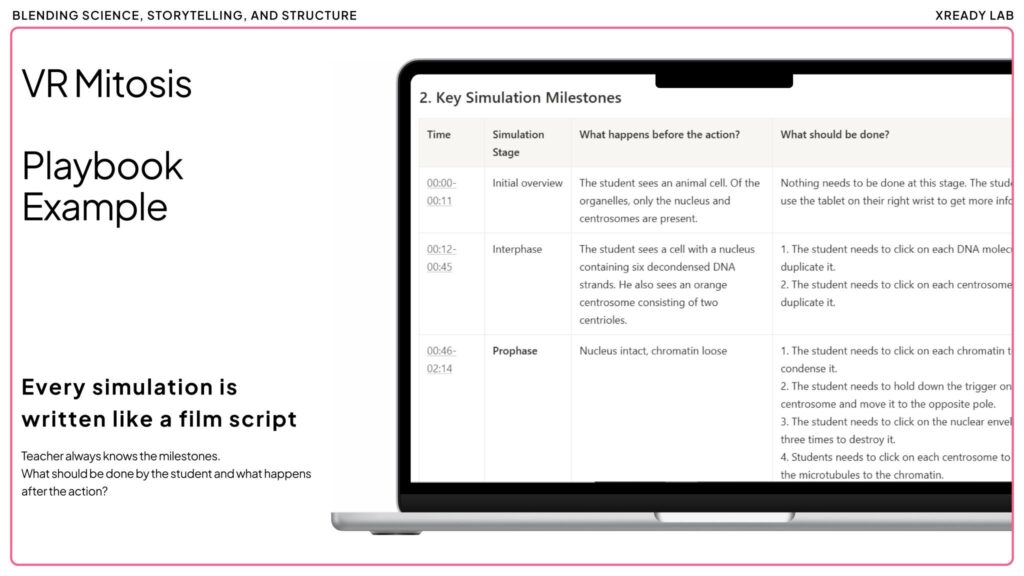
Each package comes with everything a teacher needs for smooth implementation:
General guidelines for curriculum integration
Pre-lesson setup and group organization
In-simulation prompts and observation tasks
Post-lesson analysis, reflection, and assessment
Troubleshooting checklists and technical guides
Even teachers with no prior VR experience can confidently lead sessions.
👉 Request the Full Teacher Playbook
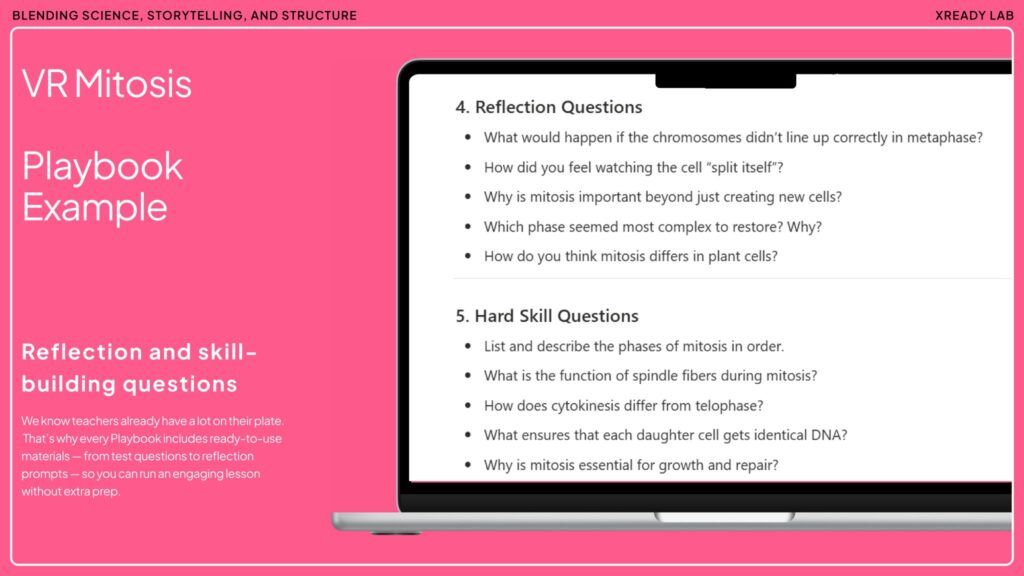
For schools, the “Future Neuroscientist and Psychologist” package is not just a digital product – it’s a gateway to modern education.
Fully aligned with international standards (IB, NGSS, TEKS, Cambridge, CBSE, College Board)
Complimentary teacher training included
Ready-to-use playbooks and reflection materials
Active learning through gamified and experimental content
Students gain practical experience in analysis, observation, and reasoning – essential skills for any scientific or medical career.
Tomorrow’s neuroscientists and psychologists will not just memorize facts – they will understand how the mind and body interact, how hormones influence emotion, and how neurons build thought.
And their journey can start now, in a classroom that gives them access to tools scientists once only dreamed of.
With XReady Lab’s Future Neuroscientist and Psychologist package, schools can turn biology lessons into a meaningful step toward careers in brain science, medicine, and human behavior.
👉 Launch XReady Lab in Your School
Frequently Asked
XReady Lab offers the largest K–12 STEM VR and Web/PC library with an AI Tutor. The packages include biology, physics, chemistry, and math, covering topics from primary school through high school.
All content is designed to align with major curricula and deliver engaging, interactive learning experiences. New simulations are added monthly.
XReady Lab’s simulations are aligned with IB, Cambridge IGCSE, AS & A Levels, NGSS, College Board, Common Core, TEKS, CBSE, BNCC, the National Curriculum for England, the Italian secondary school curriculum (Scuola Secondaria), and the National Curriculum of the Netherlands (VMBO, HAVO, VWO).
Career Packs are VR simulation bundles that let students explore STEM careers in practice. Current packs include: Future Doctor, Future Nurse, Future Engineer, Future HVAC Engineer, Future Biotechnologist, Future Astronomer, Future Neuroscientist.
New Career Packs are added regularly.
XReady Lab Superhuman AI Tutor works like a real tutor, guiding students step by step instead of giving ready-made answers. It focuses on reasoning, problem-solving, and explaining mistakes to build real understanding.
Created by international STEM Olympiad winners and coaches, it helps prepare for exams, increases memory retention by 40%, and works in real time in both VR and desktop formats with an internet connection.
XReady Lab packages include complimentary teacher training and ready-to-use Lesson Plans and Engagement Playbooks to support engaging lessons.
They guide teachers in integrating VR/web/PC simulations with clear objectives, step-by-step instructions, classroom management strategies, reflection activities, assessments, and technical checklists — helping teachers run effective lessons beyond the simulations themselves.
Simply fill out the free demo form here to get access to demo XReady Lab simulations.
We start with consultation: our team helps plan the VR classroom for your school. You need internet access and a suitable room — allocate about 5 x 5 feet (1.5 x 1.5 m) per student. One headset per two students works well.
Devices and licenses: schools can use existing Meta Quest or Pico devices and purchase licenses, or we can offer discounted devices or a turnkey solution with pre-installed content.
After purchase, we guide device setup and content installation and provide teacher training.
Teachers learn how to run VR lessons using Lesson Plans and Engagement Playbooks, manage screen casting and paired learning, and keep students engaged.
Ongoing support is always available.
VR lessons typically last 5–15 minutes, depending on the simulation, with a recommended class size of up to 20 students. Screen casting is supported and compatible with selected teacher management systems, allowing teachers to launch simulations remotely, monitor progress, and view all devices during lessons.
Teachers are supported with Lesson Plans and Engagement Playbooks that include learning objectives, step-by-step lesson flow, classroom scenarios, reflection questions, practical assignments, and assessment guidance.
XReady Lab is available worldwide and supports 75+ languages. Today, it is used by 800+ schools and 150,000+ students across the globe.
XReady Lab simulations are offered through flexible licensing packages, depending on the format and subjects you need:
If you already have VR headsets, you only purchase licenses. If not, we can also help you choose the most cost-effective setup and licensing model for your school or family.
XReady Lab works with the most widely used standalone VR headsets in schools:
All supported devices are standalone (no PC required), making them easy to deploy and manage in a school environment.
Yes. XReady Lab supports open ecosystems, not closed platforms. Schools can freely use third-party VR content alongside XReady Lab on Meta Quest and PICO headsets.
We encourage schools to diversify their VR classrooms with high-quality educational apps and can recommend tested solutions, helping expand learning beyond STEM into subjects like design, history, environmental studies, and soft skills.
XReady Lab follows school VR safety best practices. VR is recommended for students 10–12+, with short 5–15 minute sessions and seated or safe-zone use under teacher supervision, supported by screen casting.
First-time users adapt gradually. Students with medical conditions require parental and school approval, and hygiene is ensured through regular headset cleaning and replaceable face covers.
Families can access XReady Lab simulations at home in two ways:
