


Imagine students exploring the vastness of space from their classrooms or dissecting a virtual frog with the swipe of a finger. VR technology has unlocked limitless possibilities for interactive learning, transcending traditional textbooks and lectures. By immersing students in realistic simulations, we can foster curiosity, engagement, and deeper understanding across various subjects.
Check out this XReady Lab video about virtual STEM eduverse.
Virtual reality allows for safe experimentation and exploration of scenarios that are impossible in real life. From traveling through space and back in time to studying marine life underwater and handling dangerous biological samples, VR makes everything possible.
We should also discuss the potential of XR in education—a concept that combines virtual, augmented, and mixed reality. Augmented reality (AR) overlays digital content onto the real world, while mixed reality (MR) combines virtual elements with the physical environment, enabling interactive simulations for hands-on learning, enhancing students’ engagement and comprehension.
AI-driven adaptive learning platforms are reshaping the educational landscape by catering to each student’s unique needs and learning pace. AI technology anticipates individual learning patterns, facilitating the creation of customized educational content aligned with each learner’s objectives and prior accomplishments. AI tools enable educators to personalize learning journeys according to students’ unique needs, preferences, and cognitive approaches.
Through intelligent algorithms, educators can track individual progress, identify areas for improvement, and deliver personalized content tailored to students’ strengths and weaknesses. This personalized approach not only enhances academic performance but also nurtures confidence and a love for learning.
Check out some Duolingo examples of personalizing learning through AI in the video.
The Internet of Things (IoT) refers to a vast interconnected network of physical objects embedded with sensors, software, and various technologies. These “things” gather and exchange data with other devices and systems via the Internet, enabling users to monitor and manage devices remotely.
IoT technology offers significant advantages for individualized education. By leveraging IoT devices, educational institutions can gather detailed insights into each student’s unique learning needs and progress. These insights enable educators to customize lessons and provide targeted support to enhance student success.
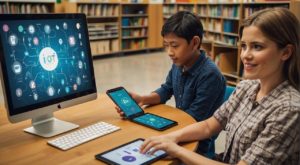
In addition to personalized learning, IoT devices, including sensors, cameras, and interactive whiteboards, are instrumental in creating smart classrooms. These devices facilitate the monitoring of classroom dynamics, student participation, and real-time feedback for both students and teachers. Wearable technologies like fitness trackers and smartwatches can capture data on students’ physical activity, sleep habits, and focus levels. This information helps tailor learning experiences and identify students needing additional assistance.
IoT-enabled sensors also facilitate hands-on experiments in science and engineering, providing students with tangible tools to explore complex concepts and develop problem-solving skills in a real-world context.
The concept of the “metaverse” is currently trending, often associated with gaming and entertainment. However, its scope extends far beyond that, encompassing areas like education.
The metaverse is a persistent virtual realm where individuals use avatars to engage with the environment and interact with one another in real time.
The Metaverse can enrich conventional educational methods with its array of virtual environments, platforms, and resources that enhance and elevate the delivery of educational content and interaction. It also fosters global cooperation and cultural exchange among learners and instructors, breaking geographical barriers and enabling collaboration, knowledge exchange, and insights from diverse cultural perspectives.
Check out our recent articles about a case study of a Japanese school that exists entirely in the metaverse, as well as an introductory article about metaverse teacher tools that you can start using with just a smartphone or computer.
LINK
LINK
At XReady Lab, our mission is to empower educators with innovative tools that ignite curiosity, spark creativity, and foster lifelong learning. Through our extensive library of VR STEM simulations, we aim to create a learning environment where students are not merely passive consumers of information but active participants in their educational journey.
Try our free demo of virtual reality STEM simulations:
As we continue to push the boundaries of educational technology, we invite educators and stakeholders to join us in revolutionizing K-12 education. Together, we can harness the transformative power of VR, AI, robotics, IoT, and collaborative tools to inspire the next generation of thinkers, innovators, and leaders!
You may like it
Frequently Asked
XReady Lab offers the largest K–12 STEM VR and Web/PC library with an AI Tutor. The packages include biology, physics, chemistry, and math, covering topics from primary school through high school.
All content is designed to align with major curricula and deliver engaging, interactive learning experiences. New simulations are added monthly.
XReady Lab’s simulations are aligned with IB, Cambridge IGCSE, AS & A Levels, NGSS, College Board, Common Core, TEKS, CBSE, BNCC, the National Curriculum for England, the Italian secondary school curriculum (Scuola Secondaria), and the National Curriculum of the Netherlands (VMBO, HAVO, VWO).
Career Packs are VR simulation bundles that let students explore STEM careers in practice. Current packs include: Future Doctor, Future Nurse, Future Engineer, Future HVAC Engineer, Future Biotechnologist, Future Astronomer, Future Neuroscientist.
New Career Packs are added regularly.
XReady Lab Superhuman AI Tutor works like a real tutor, guiding students step by step instead of giving ready-made answers. It focuses on reasoning, problem-solving, and explaining mistakes to build real understanding.
Created by international STEM Olympiad winners and coaches, it helps prepare for exams, increases memory retention by 40%, and works in real time in both VR and desktop formats with an internet connection.
XReady Lab packages include complimentary teacher training and ready-to-use Lesson Plans and Engagement Playbooks to support engaging lessons.
They guide teachers in integrating VR/web/PC simulations with clear objectives, step-by-step instructions, classroom management strategies, reflection activities, assessments, and technical checklists — helping teachers run effective lessons beyond the simulations themselves.
Simply fill out the free demo form here to get access to demo XReady Lab simulations.
We start with consultation: our team helps plan the VR classroom for your school. You need internet access and a suitable room — allocate about 5 x 5 feet (1.5 x 1.5 m) per student. One headset per two students works well.
Devices and licenses: schools can use existing Meta Quest or Pico devices and purchase licenses, or we can offer discounted devices or a turnkey solution with pre-installed content.
After purchase, we guide device setup and content installation and provide teacher training.
Teachers learn how to run VR lessons using Lesson Plans and Engagement Playbooks, manage screen casting and paired learning, and keep students engaged.
Ongoing support is always available.
VR lessons typically last 5–15 minutes, depending on the simulation, with a recommended class size of up to 20 students. Screen casting is supported and compatible with selected teacher management systems, allowing teachers to launch simulations remotely, monitor progress, and view all devices during lessons.
Teachers are supported with Lesson Plans and Engagement Playbooks that include learning objectives, step-by-step lesson flow, classroom scenarios, reflection questions, practical assignments, and assessment guidance.
XReady Lab is available worldwide and supports 75+ languages. Today, it is used by 800+ schools and 150,000+ students across the globe.
XReady Lab simulations are offered through flexible licensing packages, depending on the format and subjects you need:
If you already have VR headsets, you only purchase licenses. If not, we can also help you choose the most cost-effective setup and licensing model for your school or family.
XReady Lab works with the most widely used standalone VR headsets in schools:
All supported devices are standalone (no PC required), making them easy to deploy and manage in a school environment.
Yes. XReady Lab supports open ecosystems, not closed platforms. Schools can freely use third-party VR content alongside XReady Lab on Meta Quest and PICO headsets.
We encourage schools to diversify their VR classrooms with high-quality educational apps and can recommend tested solutions, helping expand learning beyond STEM into subjects like design, history, environmental studies, and soft skills.
XReady Lab follows school VR safety best practices. VR is recommended for students 10–12+, with short 5–15 minute sessions and seated or safe-zone use under teacher supervision, supported by screen casting.
First-time users adapt gradually. Students with medical conditions require parental and school approval, and hygiene is ensured through regular headset cleaning and replaceable face covers.
Families can access XReady Lab simulations at home in two ways:
