


What if students could step inside a bloodstream, chase down toxin molecules, activate enzymes, and literally repair a cell from the inside?
That is exactly what happens in VR Enzymes – Interactive Biology Lab.
VR Enzymes is now available as a standalone lab in the Pico Store.
That means you do not need to purchase the full secondary school STEM package to try it. If you want to explore how immersive molecular biology feels in practice, you can access the Enzymes lab independently and experience it right away.
Explore VR Enzymes in the Pico Store here:
https://store-global.picoxr.com/global/detail/1/7527023251068010502?is_new_connect=0&is_new_user=0
If you have been curious about bringing VR into your biology classroom but were not ready for a full program commitment, this is the perfect entry point.
VR Enzymes is an immersive high school biology simulation where students are exposed to a dangerous toxin and must survive by activating enzymes and restoring cellular function.
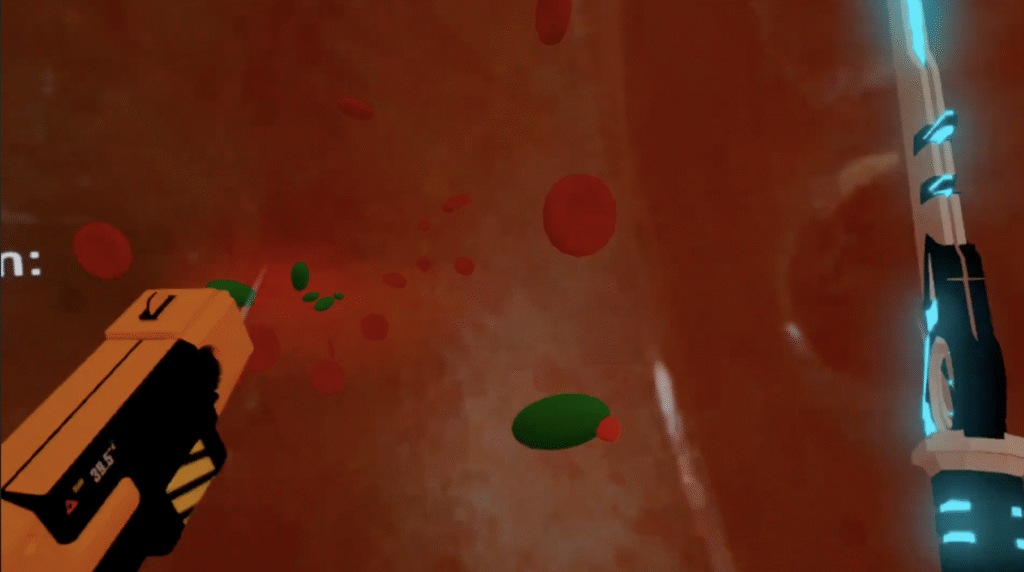
Instead of memorizing terms like transcription, translation, or sodium-potassium pump, learners travel through:
They interact with real biological mechanisms in sequence.
You are not watching biology.
You are performing it.
This is where it gets powerful.
Students do not just click through slides. They act.
Inside VR, they:
Each decision changes the molecular state of the cell.
If something is repaired, the system stabilizes.
If something is ignored, dysfunction spreads.
And suddenly enzymes are not abstract. They are survival tools.
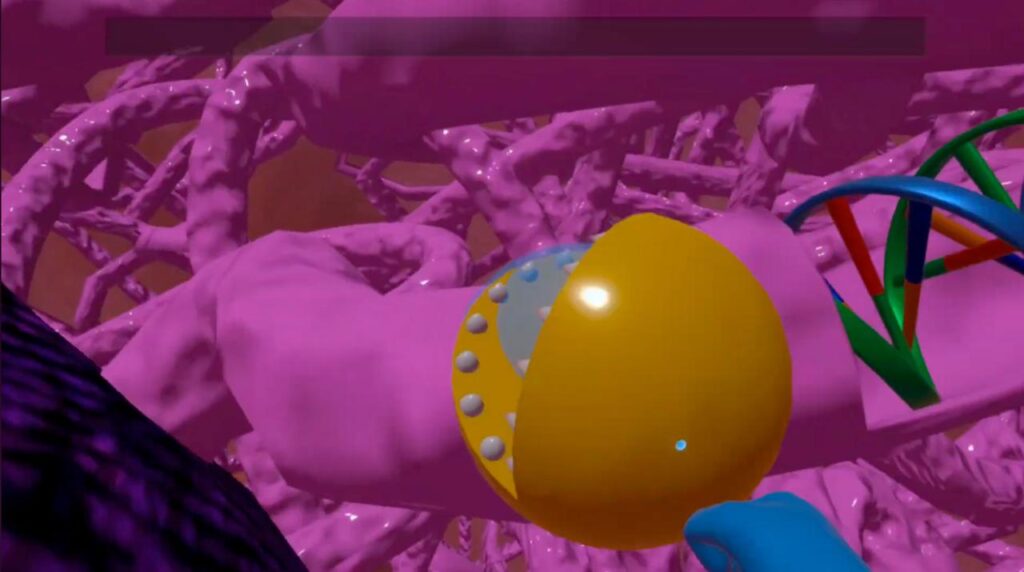
The focus is not memorizing enzyme names. It is conceptual clarity.
Students develop understanding of:
Instead of remembering definitions, learners see cause and effect.
That shift matters.
Let’s be honest. Enzymes are one of the hardest topics to teach well.
They are invisible. Microscopic. Abstract. Full of diagrams and arrows.
VR changes that.
In a traditional classroom, a teacher explains how ATP synthase rotates and generates energy.
In VR, students collect ATP synthase subunits and repair the structure themselves.
In a textbook, transcription is a labeled diagram.
In VR, students unzip DNA strands and build mRNA with their own hands.
That physical interaction creates durable memory. Research consistently shows immersive learning improves retention, and in practice, students remember what they manipulate.
You do not forget what you fix.
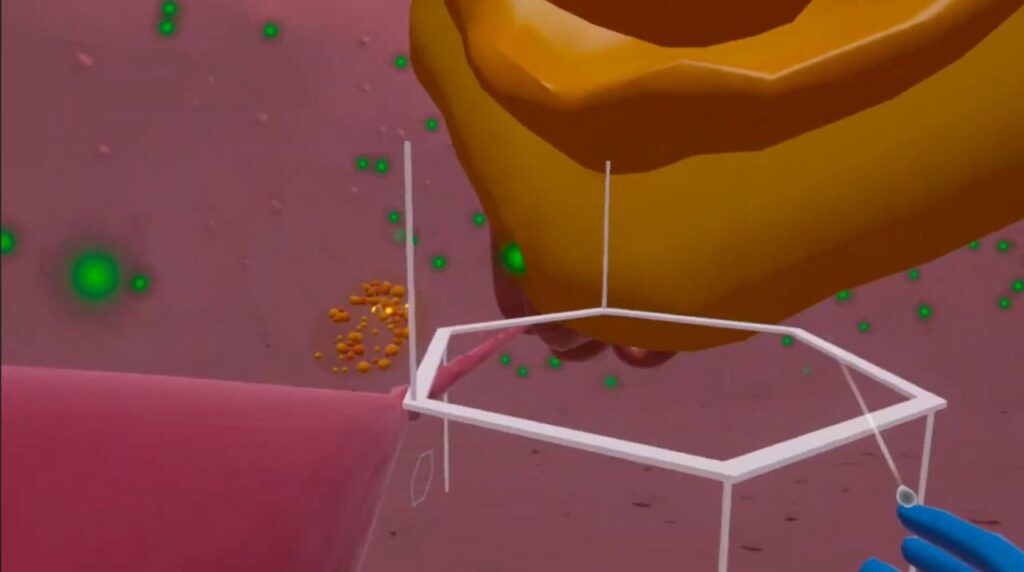
This simulation was developed by winners and coaches of international science Olympiads, in collaboration with scientists from MIT, Harvard, and EPFL.
That matters.
Because strong visuals are not enough. The science has to be correct. The pedagogical flow has to be intentional.
This lab was designed not as entertainment, but as structured biological reasoning.
VR Enzymes is primarily recommended for High School biology students, ages 13-18.
It can also be used in Middle School as an advanced or enrichment module.
The content aligns with major curricula including:
For schools, extended packages include:
Schools can request structured implementation support here:
https://xreadylab.com/request-demo-page/launch-in-classrooms/?utm_source=website&utm_medium=blogeng&utm_campaign=enzymes0226
Biology education is shifting from memorization to systems thinking.
Students entering medicine, biotechnology, genetics, and bioengineering need to understand interactions, not just vocabulary.
Enzymes are central to:
If students understand enzymes deeply, they understand life processes at a systems level.
VR does not replace teachers. It amplifies explanation through experience.
The real learning often happens during discussion after the VR session. Students describe what they saw, what they changed, and what surprised them. That is where conceptual understanding solidifies.
Recommended for:
Also suitable for:
Ages:
13-18
Enzymes are not static shapes in a textbook.
They are dynamic biological tools that keep cells alive every second.
When students repair molecular damage, generate ATP, and synthesize proteins in VR, they stop asking, “Why do we need to know this?”
They start asking, “What happens if this fails?”
That is real biological thinking.
You can explore the standalone VR Enzymes lab directly in the Pico Store here:
https://store-global.picoxr.com/global/detail/1/7527023251068010502?is_new_connect=0&is_new_user=0
And if you are interested in implementing the full secondary school STEM package, including structured biology, physics, and chemistry labs aligned with major curricula, request a demo and our team will contact you to discuss how it can work in your classroom:
https://xreadylab.com/request-demo-page/launch-in-classrooms/?utm_source=website&utm_medium=blogeng&utm_campaign=enzymes02
1. What is the VR Enzymes lab?
An interactive VR biology simulation where students enter a cell, activate enzymes, repair molecular damage, and restore cellular function step by step.
2. What do students actually do inside VR?
They neutralize toxins, split DNA, run transcription and translation, generate ATP, and repair ATP synthase in mitochondria.
3. What topics does it cover?
Enzyme specificity, transcription, translation, ATP production, membrane transport, and organelle functions.
4. Is it aligned with school curricula?
Yes. It aligns with IB, NGSS, TEKS, College Board, Cambridge, CBSE, and other major programs.
5. Who is it for?
Primarily High School students aged 13–18, with advanced use possible in Middle School.
6. Can schools use it as part of a full STEM package?
Yes. It is available within broader school packages covering biology, physics, and chemistry.
Frequently Asked
XReady Lab offers the largest K–12 STEM VR and Web/PC library with an AI Tutor. The packages include biology, physics, chemistry, and math, covering topics from primary school through high school.
All content is designed to align with major curricula and deliver engaging, interactive learning experiences. New simulations are added monthly.
XReady Lab’s simulations are aligned with IB, Cambridge IGCSE, AS & A Levels, NGSS, College Board, Common Core, TEKS, CBSE, BNCC, the National Curriculum for England, the Italian secondary school curriculum (Scuola Secondaria), and the National Curriculum of the Netherlands (VMBO, HAVO, VWO).
Career Packs are VR simulation bundles that let students explore STEM careers in practice. Current packs include: Future Doctor, Future Nurse, Future Engineer, Future HVAC Engineer, Future Biotechnologist, Future Astronomer, Future Neuroscientist.
New Career Packs are added regularly.
XReady Lab Superhuman AI Tutor works like a real tutor, guiding students step by step instead of giving ready-made answers. It focuses on reasoning, problem-solving, and explaining mistakes to build real understanding.
Created by international STEM Olympiad winners and coaches, it helps prepare for exams, increases memory retention by 40%, and works in real time in both VR and desktop formats with an internet connection.
XReady Lab packages include complimentary teacher training and ready-to-use Lesson Plans and Engagement Playbooks to support engaging lessons.
They guide teachers in integrating VR/web/PC simulations with clear objectives, step-by-step instructions, classroom management strategies, reflection activities, assessments, and technical checklists — helping teachers run effective lessons beyond the simulations themselves.
Simply fill out the free demo form here to get access to demo XReady Lab simulations.
We start with consultation: our team helps plan the VR classroom for your school. You need internet access and a suitable room — allocate about 5 x 5 feet (1.5 x 1.5 m) per student. One headset per two students works well.
Devices and licenses: schools can use existing Meta Quest or Pico devices and purchase licenses, or we can offer discounted devices or a turnkey solution with pre-installed content.
After purchase, we guide device setup and content installation and provide teacher training.
Teachers learn how to run VR lessons using Lesson Plans and Engagement Playbooks, manage screen casting and paired learning, and keep students engaged.
Ongoing support is always available.
VR lessons typically last 5–15 minutes, depending on the simulation, with a recommended class size of up to 20 students. Screen casting is supported and compatible with selected teacher management systems, allowing teachers to launch simulations remotely, monitor progress, and view all devices during lessons.
Teachers are supported with Lesson Plans and Engagement Playbooks that include learning objectives, step-by-step lesson flow, classroom scenarios, reflection questions, practical assignments, and assessment guidance.
XReady Lab is available worldwide and supports 75+ languages. Today, it is used by 800+ schools and 150,000+ students across the globe.
XReady Lab simulations are offered through flexible licensing packages, depending on the format and subjects you need:
If you already have VR headsets, you only purchase licenses. If not, we can also help you choose the most cost-effective setup and licensing model for your school or family.
XReady Lab works with the most widely used standalone VR headsets in schools:
All supported devices are standalone (no PC required), making them easy to deploy and manage in a school environment.
Yes. XReady Lab supports open ecosystems, not closed platforms. Schools can freely use third-party VR content alongside XReady Lab on Meta Quest and PICO headsets.
We encourage schools to diversify their VR classrooms with high-quality educational apps and can recommend tested solutions, helping expand learning beyond STEM into subjects like design, history, environmental studies, and soft skills.
XReady Lab follows school VR safety best practices. VR is recommended for students 10–12+, with short 5–15 minute sessions and seated or safe-zone use under teacher supervision, supported by screen casting.
First-time users adapt gradually. Students with medical conditions require parental and school approval, and hygiene is ensured through regular headset cleaning and replaceable face covers.
Families can access XReady Lab simulations at home in two ways:
