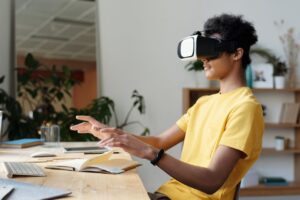
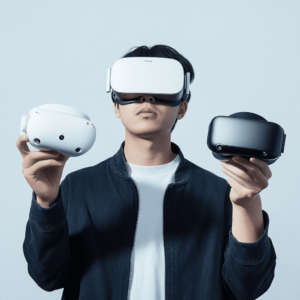
Physics is a fascinating yet complex subject that truly comes to life when students can get hands-on and experience the principles in action. Traditionally, schools have relied on textbooks and limited STEM labs for teaching physics, but VR education is now transforming the way students learn. With virtual reality in the classroom, students are not just learning about complex concepts—they are experiencing them firsthand. Imagine observing Coulomb’s Law in action or navigating through the solar system—all while seated at your desk. This immersive experience leads to a deeper understanding and long-lasting retention of the material.
Imagine stepping into a VR classroom where the laws of physics unfold before your eyes. At XReady Lab, we’ve designed virtual reality learning platforms that allow students to experience scientific principles like never before. Our STEM labs transform challenging physics concepts into interactive experiences, making it easier for students to grasp and apply what they learn in real-world scenarios:
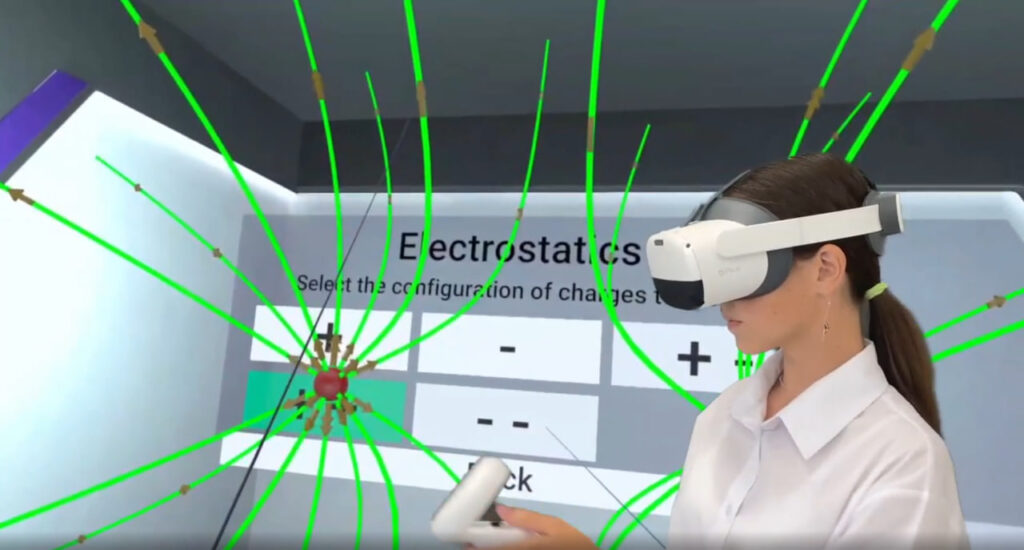
Coulomb’s Law:
Instead of reading about electric charges, students can visualize and interact with charged particles, observing how they influence each other in a virtual reality classroom.
Solar System Exploration:
Travel through the solar system with virtual reality in education, where students can navigate between planets and understand the physics of planetary motion.
Electrification and Field Visualization:
With VR in schools, students can explore electric fields and their effects in real-time, making abstract concepts more tangible.
Diffraction and Light Behavior:
Our interactive classroom activities include simulations of light diffraction, helping students visualize wave behavior and interference in a more accessible way.
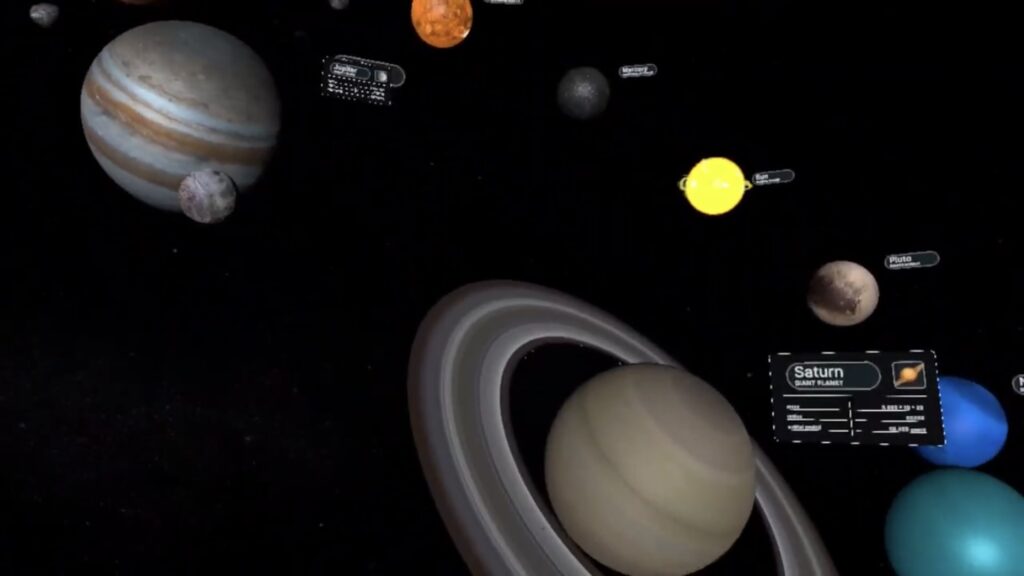
One of the most captivating applications of VR education in physics is the ability to travel through the solar system in 3D. Instead of viewing static images in a textbook, students can now orbit planets, zoom in on moons, and explore the dynamics of celestial bodies in real-time. This interactive classroom experience fosters a deeper understanding of planetary motion, gravity, and the scale of our solar system. With virtual reality in education, students don’t just learn about the universe—they can explore it.
Many physics experiments are too expensive or impractical to conduct in a typical STEM lab school. This is where VR for education comes in. With virtual reality classrooms, students can explore these otherwise unattainable experiments:
Laser Experiments:
Handling high-powered lasers is usually too dangerous for the classroom. But with VR headsets, students can safely experiment with laser optics, explore beam paths, and understand diffraction patterns—all without any risk.
Elementary Particle Visualization:
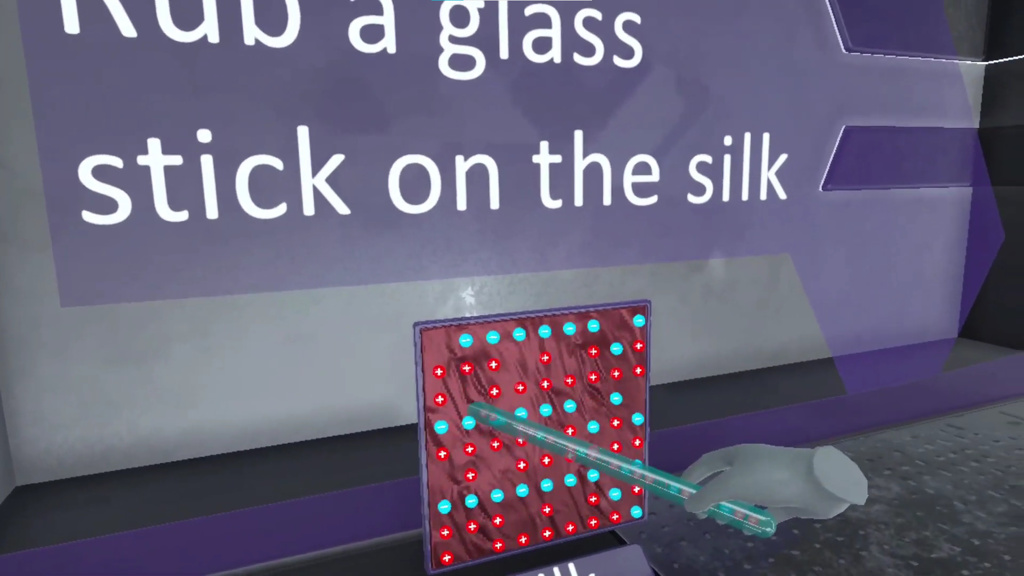
Learning in VR makes understanding quantum mechanics and particle interactions much easier by visualizing these processes on a fundamental level.
Vector Visualization:
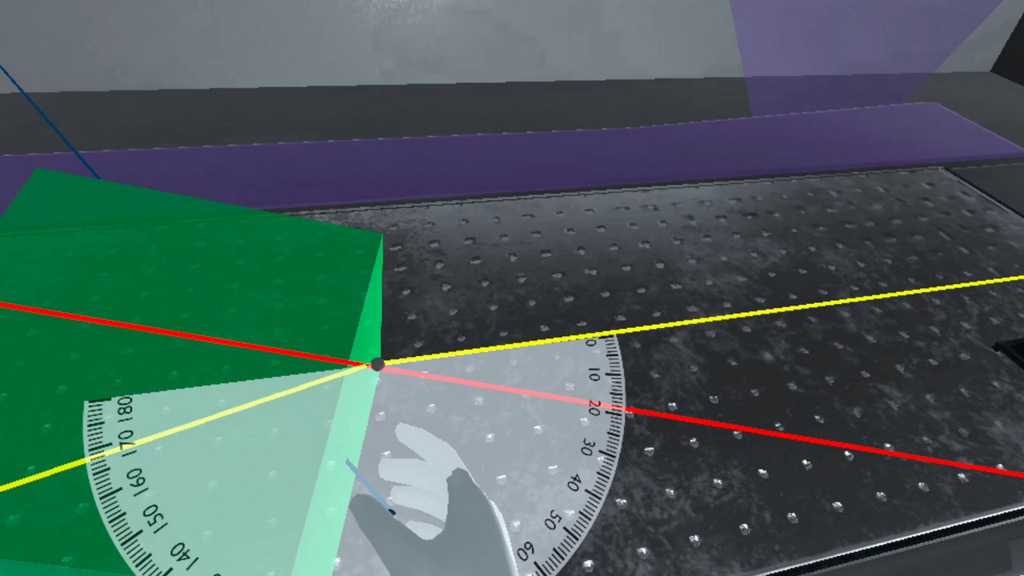
In our interactive classrooms, students can manipulate vectors in 3D, gaining a better understanding of force, magnitude, and direction.
Traditional labs often come with safety risks and high costs, making certain experiments impossible. VR technology eliminates these obstacles, allowing students to explore advanced physics concepts—like high-voltage circuits or quantum mechanics—in a completely safe and cost-effective virtual environment. For example, working with dangerous high-voltage equipment or hazardous materials becomes possible in a virtual reality classroom without endangering students. Additionally, VR headsets for schools provide an affordable way for institutions to access simulations of advanced physics experiments that would otherwise be out of reach. This level of safety and accessibility is one of the key benefits of VR in education, ensuring that all students have access to cutting-edge learning tools in a risk-free environment.
The benefits of virtual reality in education are clear. Students using VR learning solutions are more engaged, can retain information better, and have the ability to interact with complex concepts in real-time. By introducing virtual reality for learning into the classroom, educators can bridge the gap between theoretical and practical understanding.
With VR, the digital classroom becomes a dynamic learning environment where students can experiment and explore without the usual limitations of time, space, or budget. This makes VR in education not just a tool for engagement but a necessity for preparing students for the future.
Imagine your students not just reading about physics concepts but actively exploring them through virtual reality. Whether it’s visualizing electric fields or traveling through the solar system, VR learning makes complex ideas come to life.
Eager to see the future of physics education? Request your free demo from XReady Lab today and experience how VR can turn your classroom into a state-of-the-art learning hub. Watch as your students get excited about physics, exploring complex theories through interactive simulations that make learning both fun and effective.
Request your demo now and take your classroom into the future!
Frequently Asked
XReady Lab offers the largest K–12 STEM VR and Web/PC library with an AI Tutor. The packages include biology, physics, chemistry, and math, covering topics from primary school through high school.
All content is designed to align with major curricula and deliver engaging, interactive learning experiences. New simulations are added monthly.
XReady Lab’s simulations are aligned with IB, Cambridge IGCSE, AS & A Levels, NGSS, College Board, Common Core, TEKS, CBSE, BNCC, the National Curriculum for England, the Italian secondary school curriculum (Scuola Secondaria), and the National Curriculum of the Netherlands (VMBO, HAVO, VWO).
Career Packs are VR simulation bundles that let students explore STEM careers in practice. Current packs include: Future Doctor, Future Nurse, Future Engineer, Future HVAC Engineer, Future Biotechnologist, Future Astronomer, Future Neuroscientist.
New Career Packs are added regularly.
XReady Lab Superhuman AI Tutor works like a real tutor, guiding students step by step instead of giving ready-made answers. It focuses on reasoning, problem-solving, and explaining mistakes to build real understanding.
Created by international STEM Olympiad winners and coaches, it helps prepare for exams, increases memory retention by 40%, and works in real time in both VR and desktop formats with an internet connection.
XReady Lab packages include complimentary teacher training and ready-to-use Lesson Plans and Engagement Playbooks to support engaging lessons.
They guide teachers in integrating VR/web/PC simulations with clear objectives, step-by-step instructions, classroom management strategies, reflection activities, assessments, and technical checklists — helping teachers run effective lessons beyond the simulations themselves.
Simply fill out the free demo form here to get access to demo XReady Lab simulations.
We start with consultation: our team helps plan the VR classroom for your school. You need internet access and a suitable room — allocate about 5 x 5 feet (1.5 x 1.5 m) per student. One headset per two students works well.
Devices and licenses: schools can use existing Meta Quest or Pico devices and purchase licenses, or we can offer discounted devices or a turnkey solution with pre-installed content.
After purchase, we guide device setup and content installation and provide teacher training.
Teachers learn how to run VR lessons using Lesson Plans and Engagement Playbooks, manage screen casting and paired learning, and keep students engaged.
Ongoing support is always available.
VR lessons typically last 5–15 minutes, depending on the simulation, with a recommended class size of up to 20 students. Screen casting is supported and compatible with selected teacher management systems, allowing teachers to launch simulations remotely, monitor progress, and view all devices during lessons.
Teachers are supported with Lesson Plans and Engagement Playbooks that include learning objectives, step-by-step lesson flow, classroom scenarios, reflection questions, practical assignments, and assessment guidance.
XReady Lab is available worldwide and supports 75+ languages. Today, it is used by 800+ schools and 150,000+ students across the globe.
XReady Lab simulations are offered through flexible licensing packages, depending on the format and subjects you need:
If you already have VR headsets, you only purchase licenses. If not, we can also help you choose the most cost-effective setup and licensing model for your school or family.
XReady Lab works with the most widely used standalone VR headsets in schools:
All supported devices are standalone (no PC required), making them easy to deploy and manage in a school environment.
Yes. XReady Lab supports open ecosystems, not closed platforms. Schools can freely use third-party VR content alongside XReady Lab on Meta Quest and PICO headsets.
We encourage schools to diversify their VR classrooms with high-quality educational apps and can recommend tested solutions, helping expand learning beyond STEM into subjects like design, history, environmental studies, and soft skills.
XReady Lab follows school VR safety best practices. VR is recommended for students 10–12+, with short 5–15 minute sessions and seated or safe-zone use under teacher supervision, supported by screen casting.
First-time users adapt gradually. Students with medical conditions require parental and school approval, and hygiene is ensured through regular headset cleaning and replaceable face covers.
Families can access XReady Lab simulations at home in two ways: