menu

New in XReady Lab Physics: Spring Forces and Hooke’s Law

Q: How do you explain Hooke’s law when nothing else works?

If you’ve ever tried to explain elastic force to a student and watched their eyes glaze over, you’re not alone. Hooke’s law sounds simple in theory – “the force is proportional to the stretch” – but in practice, it’s hard for students to feel what that means. Until now.

What Is an AI Tutor?

Before we dive into springs and forces, let’s start with what makes this lab truly different.

XReady Lab’s AI STEM Tutor isn’t a chatbot that gives ready-made answers. It guides students step by step, asking questions that lead them to the solution instead of giving it away. It adapts to the learner’s pace, remembers their weak spots, and changes how it explains things based on their progress.

When a student pulls the spring too far or forgets to measure displacement, the AI doesn’t say “wrong.” It says, “What happens if you double the force? What do you notice about the stretch now?”

That’s the difference between memorization and real understanding.

A New Way to Feel Physics

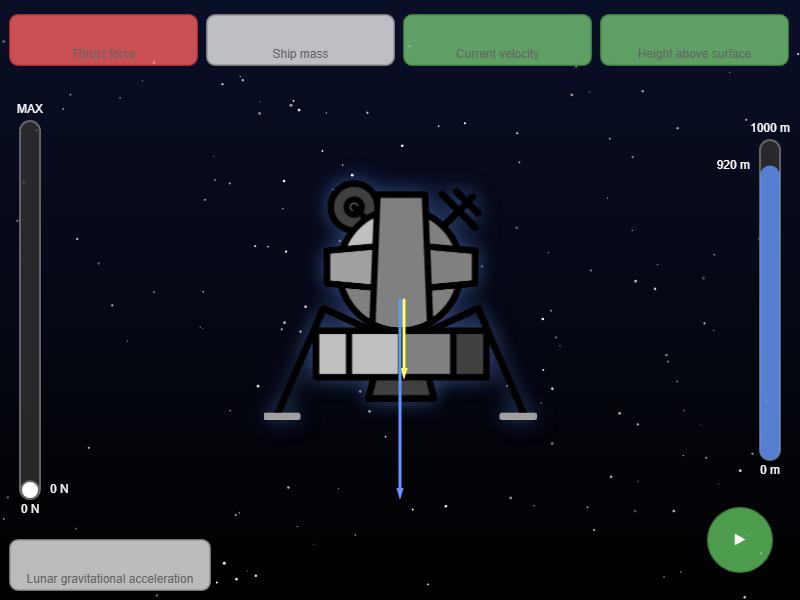
The new Spring Forces (Hooke’s Law) simulation in the XReady Lab physics pack lets students explore one of the most fundamental laws of mechanics – not by reading, but by doing.

No formulas on the board. No confusing diagrams.
Just hands-on experimentation in a digital lab where you can pull, stretch, measure, and test – as many times as you like.

Experience physics like never before with XReady Lab’s interactive web simulation on Spring Forces (Hooke’s Law). Perfect for middle school physics, whether in the classroom or at home – and no VR gear required.

Students can: compete with classmates or themselves to get better accuracy and faster results.

Gamification That Keeps Students Engaged
Every lab in XReady Lab is built on the principles of active learning and gamification. Students don’t just watch – they interact, repeat, and try to beat their previous score.

Each task feels like a small game. The more accurate your results, the higher your ranking. This light competitive element helps maintain attention, especially for students who find theory boring or abstract.

It’s the balance of play and progress that makes the concept stick.

The Game-Changer: The AI Superhuman STEM Tutor

In this new lab, the AI Superhuman STEM Tutor is always nearby, ready to help when needed.
It provides instant feedback, personalized explanations, and adjusts the difficulty based on performance.
It’s the same approach trusted by 150,000+ students worldwide, proven to deliver 40% higher memory retention compared to traditional study formats.

The content is aligned with Cambridge, IB, AP, and NGSS standards and developed by Olympiad winners and expert coaches.

So whether you’re a teacher preparing a lesson or a parent looking for an engaging way to reinforce classroom material, the AI tutor ensures every student can master physics – at their own pace.

Why This Update Matters

The Spring Forces lab adds a crucial piece to the growing XReady Lab Physics collection. It connects directly with previously released simulations on motion, gravity, and energy – creating a full, logical learning path through the mechanics module.

And the best part? The price remains the same.
Schools and individual users automatically get access to the new lab as part of their existing package.

The Bigger Picture: From Curiosity to Mastery

When students see Hooke’s law in action – when they actually pull a spring and see the numbers match the theory – something clicks.

It’s no longer “F = kx” written in chalk.
It’s a force they can feel, measure, and understand.

That’s what modern education should look like: not more information, but more interaction.

Try It Yourself

See how simple and fun physics can be.
👉 Try the new Spring Forces (Hooke’s Law) simulation

You don’t need a headset or a lab full of equipment – just curiosity and a browser.

Because understanding physics shouldn’t be about remembering formulas.
It should be about seeing the world move – and knowing why.
Our AI Tutor Was Too Smart… Until We Fixed It

“I’m afraid that AI tutors give ready-made answers,” parents often say.
Fair. Most AI tools are made exactly for that – to give fast results. You ask, they solve. You upload, they generate. Perfect for work, not for learning.

But an AI tutor isn’t supposed to do your homework. It’s supposed to teach you how to think.
And that’s where the story of our AI STEM Tutor at XReady Lab begins.

When Our AI Was Too Helpful

At one point, our AI tutor looked brilliant. You’d enter the numbers, and before you could blink, it would say:
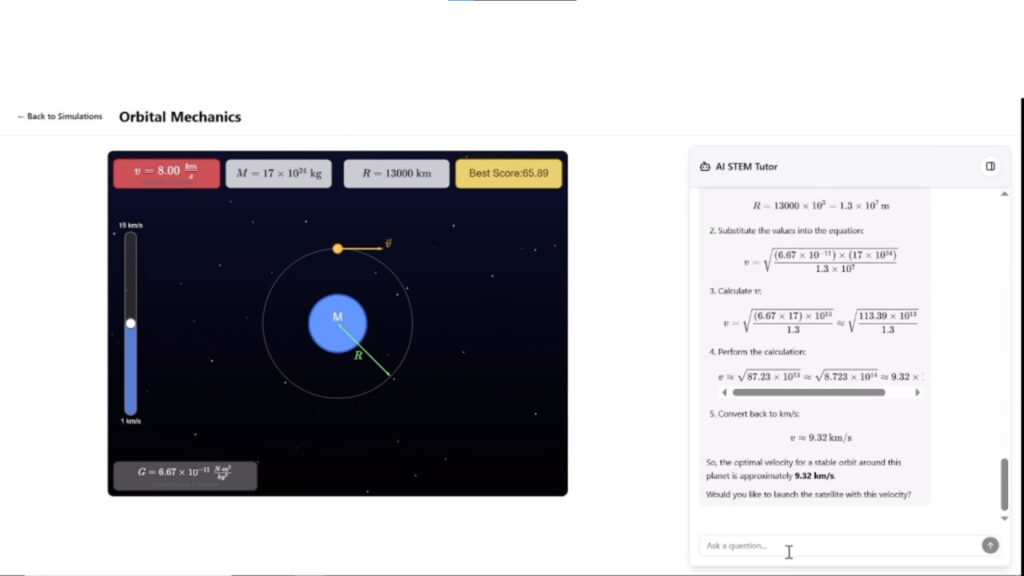
“The optimal orbital speed is 9.32 km/s.”

Accurate. Precise. Impressive, but completely wrong for learning.

Students stopped thinking. They didn’t test different values, didn’t question why the answer was 9.32, didn’t experiment at all. The AI had turned into a calculator instead of a guide.

That was the moment we understood: the worst thing an AI tutor can do is give answers too quickly.
Real understanding happens in that small pause of curiosity when the student has to connect the dots on their own.

So before releasing the product, we rebuilt the logic from scratch. Now, the tutor doesn’t just calculate. It asks, “What do you think happens if the velocity increases?” and lets the student discover the law behind the number.

Teaching the AI to Ask, Not Tell

We trained our tutor to guide, not solve.
To ask leading questions.
To provoke thought instead of feeding conclusions.

Inside a virtual lab, if a student keeps increasing velocity and getting the wrong result, the AI no longer says “the correct formula is F = ma.”
Now it says:
“Try changing the mass instead of the velocity. What happens to acceleration?”

That small shift changes everything.
Because the student is still in control. The AI is just a quiet mentor on the side, nudging the mind forward.

We call it the art of not answering – and it took months of training data, testing, and classroom pilots to get right.

The Paradox of AI Learning Tools

AI’s biggest strength is instant output.
But in education, that’s also its biggest trap.

Most tools are built to make life easier – presentations, code, essays, even math. But learning isn’t about easy. It’s about friction, mistakes, discovery.

A student who gets the right answer too quickly never remembers it.
A student who struggles a bit – and finds the logic behind it – remembers for life.

That’s why we decided: our tutor must never act like a search engine.

From Ready Answers to Real Thinking

Now, in every biology, chemistry, and physics module, our AI follows a single rule:
Never give the full answer if the student hasn’t tried yet.

Instead, it observes actions, looks for hesitation, and adjusts in real time.
If the student repeats the same error, the AI doesn’t correct – it guides.
If the student gets it right, it asks why.

This loop builds reasoning, not dependency.
And it works: memory retention in our trials grew by 40%, and over 150,000 students worldwide already use the tutor across VR and web platforms.

Because when learning feels like play – and curiosity drives progress – knowledge stays.

What Makes an AI Tutor Different

The world doesn’t need another chatbot that spits out correct formulas.
It needs something that helps kids understand them.

That’s what we built:

  • An AI that recognizes confusion before the student even types a question.
  • Hints that feel like dialogue, not commands.
  • A system aligned with IB, NGSS, and Cambridge programs – so schools can use it straight away.

We didn’t invent a teacher replacement.
We built a thinking partner.

The Lesson We Learned Ourselves

When we first saw how easily AI could answer everything, we thought we’d built the perfect tutor.
Turns out, we built the perfect cheat.

The real success came only when we stopped optimizing for speed and started optimizing for curiosity.

That’s the story of our AI tutor – not one that gives ready-made answers, but one that makes kids ask better questions.

Try It Yourself

See how it feels when AI doesn’t tell, but teaches.
👉 Try the XReady Lab AI Tutor

It’s available in both VR and web format, used by schools and families worldwide.
Biology, chemistry, math, physics – everything explained through action, not memorization.

Because the future of learning isn’t about instant answers.
It’s about the questions that stay with you.

Kids Have a Meltdown When a Video Is Longer Than 5 Minutes: Why Traditional Educational Videos No Longer Work

Q: My students ignore every video I send them. What should I do?

You’re not alone. Teachers around the world are asking the same question: why can’t today’s students watch even a short educational video anymore? Ten years ago, a documentary on the Cold War felt like a break from classwork. Today, if a video lasts more than five minutes, half the class sighs, checks out, or starts whispering.

What happened? Did attention spans really shrink, or did the way we teach fail to adapt?

When 10 Minutes Feels Like a Lifetime

Educators on Reddit describe it perfectly:

“Even if it’s a 6-minute cultural clip or a short experiment demo, students lose interest the second they see the time bar stretch beyond five minutes.”

Another teacher adds:

“They won’t even watch videos that could replace entire lessons. I upload detailed tutorials with timestamps, and they skip everything.”

The phenomenon is everywhere. Students swipe through content in seconds. YouTube, TikTok, Instagram – all have trained the brain to expect instant stimulation and zero effort. When a video doesn’t change camera angles every few seconds, attention collapses.

But this isn’t just about laziness. It’s about format fatigue.

Passive Learning Has Stopped Working

For decades, we’ve replaced textbooks with videos, thinking it would make education more engaging. And it worked… for a while.

Textbooks → Video lessons → Immersive 360° → Interactive VR and gamified labs

The problem is that every stage eventually becomes stale when it stays passive. Watching is not learning.

Even immersive 360° videos, including popular ClassVR experiences, create the same effect as long YouTube clips. The “wow” factor wears off quickly, leaving students disengaged again. They still can’t interact or test their understanding.

The New Generation Doesn’t Want to Watch – They Want to Play

The Alpha generation is growing up inside interactive systems. They don’t absorb information linearly. They explore it.

When you give them a 7-minute video on photosynthesis, they zone out. But if you let them manipulate sunlight levels and see how plants react in real time – suddenly, they care.

That’s why the next step in education isn’t another flashy video format. It’s interactive simulations and AI tutors that turn lessons into active exploration.

Enter the AI Tutor: From Watching to Doing

AI tutors are changing the rules. Instead of feeding answers, they guide students through reasoning.

When a child struggles inside a virtual lab, the AI doesn’t explain everything immediately. It asks leading questions like,

“What happens if you double the force?” or “How does mass affect acceleration here?”

This approach keeps curiosity alive. Students stay focused not because they’re forced to, but because they want to see the result.

In XReady Lab’s AI STEM platform, this model works hand-in-hand with interactive science simulations. Students can play, experiment, and learn faster – with real understanding instead of passive watching.

👉 Try it for your child: XReady Lab AI STEM Tutor
👉 For schools: Request classroom demo

Why Videos Don’t Teach – and Games Do

Modern learners don’t want to be told. They want to discover.
And gamified learning is built exactly around that.

Interactive VR and online labs combine science content with gaming logic:

  • Quick feedback loops (instant reaction to every move)

  • Levels of difficulty and visible progress

  • Competition with self or others

  • Clear rewards for understanding, not memorization

That’s why students can spend hours mastering a simulation – but not seven minutes on a video. It’s not shorter attention. It’s deeper interactivity.

For Teachers: Micro-Learning Works Better Than “Full Lessons”

A practical strategy teachers report success with:

  • Break every video into 1–2 minute fragments.

  • After each clip, ask a quick question or start a discussion.

  • Or better – switch from “watching” to “doing.”

Micro-learning keeps curiosity alive because each interaction resets the attention clock.

XReady Lab’s simulations and AI tutor are built around this principle: learn in short bursts, test instantly, move on.

For Parents: The 5-Minute Rule Isn’t a Problem – It’s a Signal

If your child can’t watch a 10-minute educational video, don’t panic. It’s not that they’ve “lost focus.” It’s that the world they learn in has changed.

They’re not wired for long passive content anymore. They need stimulation, feedback, and the ability to experiment.

Platforms like XReady Lab make learning feel like play, with AI-guided science games that match the child’s level and pace.
That’s why 150,000+ students already use it and achieve 40% higher memory retention compared to traditional study formats.

The Future of Learning: From Screens to Systems

We’re past the point where education can rely on watching videos. The next stage is active, adaptive learning – where every child learns by doing.

So when you see your students or children sigh at the sight of a 6-minute video, don’t get frustrated. They’re not broken. The method is.

Let them explore. Let them play. Let the lesson respond to them, not the other way around.

Because learning isn’t about sitting still anymore.
It’s about moving, testing, and creating knowledge that sticks.

👉 Try it for your child: XReady Lab AI STEM Tutor
👉 For schools: Request classroom demo

Will AI Tutors Help Struggling Students or Widen the Gap?

Artificial intelligence is changing classrooms faster than almost any other technology before it. What started as a few educational chatbots has now turned into full AI tutors – personalized systems that track how a student learns, identify weak spots, and guide them step by step through difficult concepts.

But here’s the big question that teachers and parents keep asking: will AI tutors really make education more equal, or will they unintentionally deepen the gap between strong and struggling students?

What Is an AI Tutor and How It Works

An AI tutor is not just a chat assistant that gives you answers. It’s an intelligent learning companion that adapts to the student. It monitors progress, notices when the student is confused, and offers hints or explanations at the exact right time.

In XReady Lab, for example, the AI STEM tutor works directly inside interactive VR and web-based science labs. When a student changes variables in a physics simulation or runs a biology experiment, the tutor watches what they do, helps them test hypotheses, and steps in when needed. It is like having a personal teacher who never gets tired, never loses patience, and always adjusts to your learning pace.

For many parents, that sounds like a dream come true. No more expensive private tutors, no waiting for teacher feedback, and no child left stuck on a problem overnight. But education is rarely that simple.

The Debate: Can AI Tutors Close the Gap or Make It Worse?

Optimists say AI tutors will personalize education in a way no human system could. Every student can move at their own speed. Fast learners can go further, and slower learners can take the time they need.

Skeptics, however, see a different picture. They argue that only motivated, self-disciplined students will actually use the AI tutor properly. The rest will ignore it – just like they ignore other free learning tools available today.

A few teachers on Reddit captured this idea perfectly:

  • u/teach1throwaway: “Students will always go to the path of least resistance.”
  • u/ajswdf: “There’s already so many free learning tools now that students don’t use, why would it being AI make a difference?”
  • u/SemiAnonymousTeacher: “There’s only a very small portion of students that have the intrinsic motivation to make good and thoughtful use of a personalized AI tutor.”
  • u/xdsm8: “All the students who have the motivation to consult AI for help don’t need it because they already pay attention in class. The ones who could benefit from AI tutoring won’t bother to seek it out.”

This fear is valid. Imagine two students sitting next to each other. One opens the AI tutor and dives into the lesson, exploring and experimenting. The other shrugs, stares out the window, and never logs in again. After a week, the gap between them has grown wider.

XReady Lab’s Perspective: It’s Not About the Tool

At XReady Lab, we see both sides clearly. Yes, the risk of widening the gap exists. But it has always existed – long before AI.

Think about it. The same argument could be made about textbooks, video lectures, or even free online courses. Every generation has access to incredible sources of knowledge, but not everyone uses them. Yet we never say books made inequality worse.

The real issue isn’t the tool. It’s motivation.

AI tutors, like books, YouTube, or VR simulations, only work when someone is willing to learn. But they also make knowledge more available than ever before. The same technology that gives an advantage to a top-performing student in London can also help a child in a small town who doesn’t have access to good teachers or private lessons.

That’s the part of the story most critics ignore.

What History Teaches Us About New Tools

When printed books became accessible centuries ago, people said the same thing: only the educated elite will benefit. But books changed the world. They took learning out of monasteries and into homes, schools, and libraries. They didn’t make the world perfectly equal, but they gave millions the ability to learn.

AI tutors are following the same pattern. Yes, motivated students will always go further. But now, more people than ever can become motivated learners because the entry barrier is lower. You no longer need to live in a city or pay for expensive lessons. You just need curiosity – and a Wi-Fi connection.

Why AI Tutors Still Matter

Here’s where AI tutors go beyond books and videos. They don’t just give information; they respond to you. They notice when you are struggling, when you skip steps, when you need encouragement.

In XReady Lab’s AI STEM Tutor, if a student keeps adjusting the same parameter in a physics lab incorrectly, the AI might say:
“Try changing mass instead of velocity. What happens to acceleration now?”

That small, real-time hint often makes the difference between confusion and clarity. Teachers can’t monitor every student at once, but an AI can.

We’ve observed a 40% increase in memory retention among students who use our AI tutor compared to traditional study formats. That’s not a small number – it means lessons actually stay in the brain longer.

But What About Motivation?

It’s true that some kids won’t use AI tutors without guidance. That’s why they shouldn’t replace teachers or parents. They should extend them.

A teacher can set goals, explain why the tool matters, and show students how to use it. Once they see it as a helper rather than a machine, curiosity follows naturally.

AI tutors are most effective when they are introduced in the right context: as a way to explore, not to copy answers. When students experiment, make mistakes, and see immediate feedback, they start learning for the sake of discovery – not grades.

The Bigger Picture

AI tutors are neither saints nor villains. They are tools. They can help close learning gaps, but they can also expose them if not guided properly. What matters most is how we use them.

At XReady Lab, we believe in combining AI tutoring with hands-on experimentation. Our VR and web-based STEM simulations let students test, adjust, and observe scientific phenomena while the AI explains the logic behind every step. It’s not just about memorization. It’s about understanding.

You can explore our AI STEM Tutor here:
👉 XReady Lab AI STEM Tutor

Trusted by over 150,000 students worldwide, it offers interactive science games, personalized feedback, and curriculum alignment with IB, NGSS, and Cambridge programs. It’s a new kind of classroom where students learn through action, not pressure.

Final Thought

Will AI tutors widen the gap between strong and struggling students? Possibly – if we let them sit unused. But when used right, they can make learning personal, accessible, and even fun.

Every new educational tool, from books to computers, first scared people. Then it changed how we learn forever. AI tutors will be the same. They won’t replace human teachers or motivation, but they will make knowledge more reachable than ever before.

Because the real question is not “Will AI make the gap wider?”
It’s “How can we use it to make learning fairer for everyone?”