Q&A: How can a student start an HVAC career before graduation?
Earlier than most people think. Much earlier.
The HVAC engineer of the future does not appear out of nowhere after college. That path starts in school, when students first understand how air moves, how heat transfers, why pressure matters, and what happens to air quality inside buildings. In other words, it starts with physics, biology, and chemistry taught the right way.
Heating, Ventilation, and Air Conditioning is not just about fixing units or installing ducts. It is one of the most critical engineering fields in modern cities, tied directly to health, energy efficiency, climate control, and smart buildings.
And demand is not slowing down.
HVAC engineering sits quietly behind almost every modern building, but without it, nothing works.
The profession is growing fast for several reasons:
Green buildings and energy efficiency standards are expanding nationwide
Post-COVID ventilation regulations are stricter than ever
Smart buildings rely on sensors, automation, and airflow optimization
Aging infrastructure requires constant modernization
Skilled technicians and engineers are in short supply, especially in the US
From a STEM perspective, HVAC engineering is applied science at its most practical. It combines physics of air and heat, electricity and sensors, optics for measurement systems, and biology and chemistry for air quality control.
That combination makes HVAC engineering both future-proof and deeply technical.
Most students meet HVAC concepts too late. By the time they reach vocational or technical programs, they are already expected to understand pressure, temperature, electricity, and gas behavior.
That gap is costly.
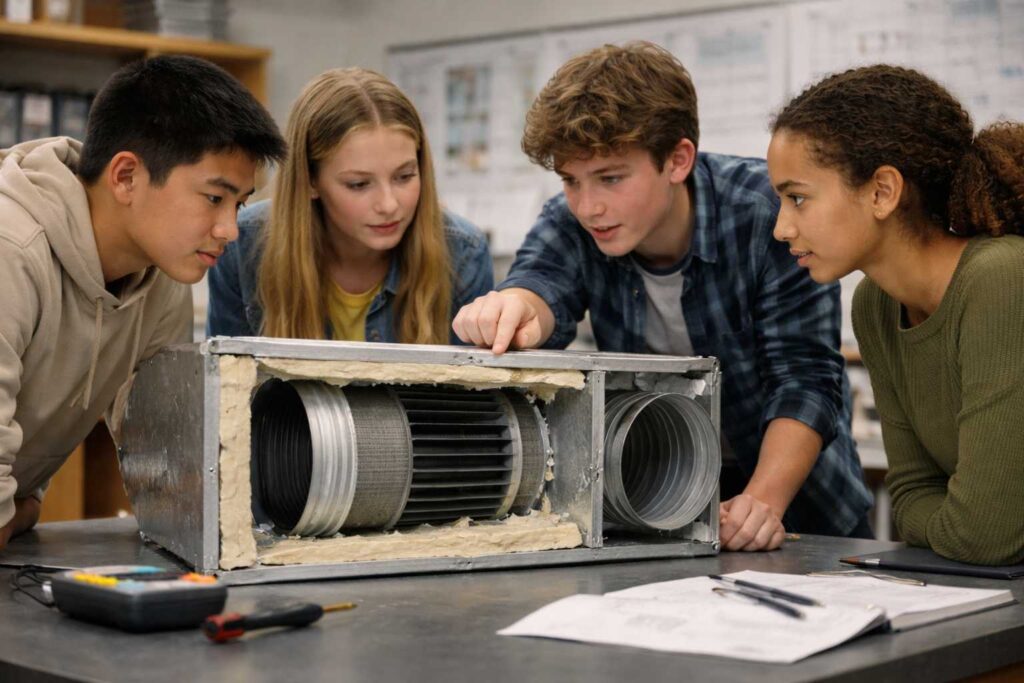
When students begin exploring HVAC fundamentals in school, they do not just memorize formulas. They start seeing buildings as systems. They understand why airflow matters, how sensors read data, and how small changes in temperature or humidity affect human health.
This is where early exposure matters.
Schools can provide this foundation through structured, career-focused learning blocks built around interactive labs rather than passive lectures.
Traditional lessons struggle to explain invisible processes. You cannot easily see pressure differences, heat transfer, or airflow patterns on a whiteboard.
VR solves this problem.
With immersive simulations, students do not watch systems work. They interact with them.
Research-backed immersive learning improves memory retention by up to 40 percent. More importantly, students remember why something happens, not just what happens.
Once you have adjusted system parameters yourself, made mistakes, and corrected them, the knowledge sticks.
The Future HVAC Engineer package is designed to teach the fundamentals of HVAC through school-level physics, chemistry, and biology, aligned with real engineering logic.
All simulations are aligned with IB, NGSS, TEKS College Board, Cambridge, CBSE, and other national and international programs. This makes the package easy to integrate into existing curricula without rewriting lesson plans from scratch.
Schools also receive:
Complimentary teacher training
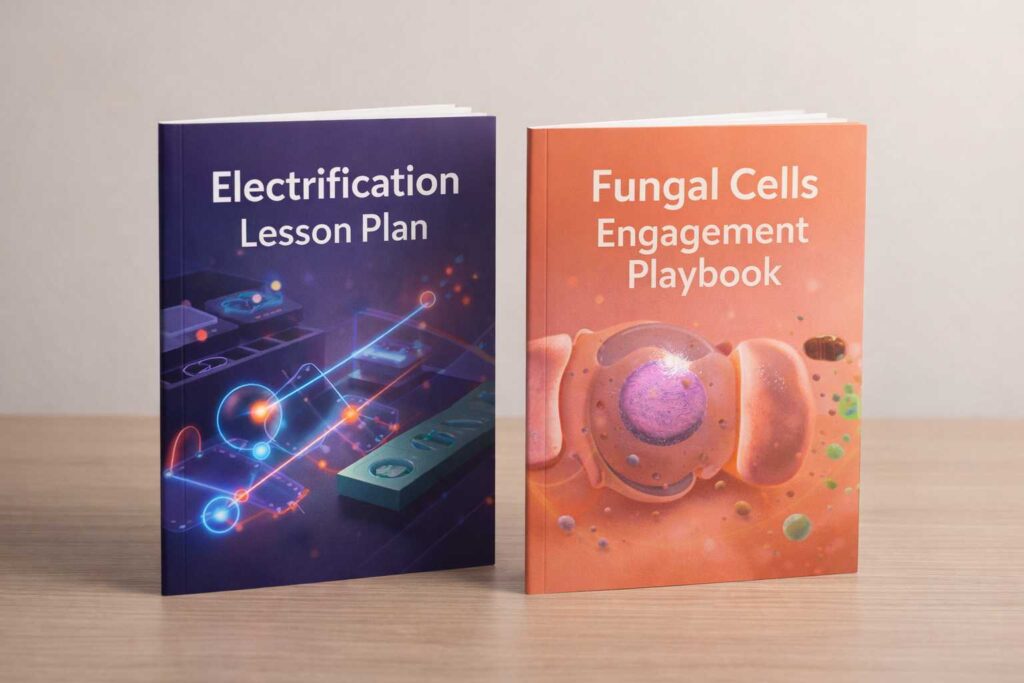
Ready-to-use lesson plans and engagement playbooks
Clear instructions for before, during, and after each simulation
Reflection, analysis, and assessment tasks
Troubleshooting checklists to ensure smooth classroom use
This is not a set of isolated labs. It is a complete instructional system.
Understand how electric charges redistribute between objects
Explore electrification through friction, contact, and induction
Develop practical skills in identifying and analyzing electric charges
This builds the foundation for understanding how HVAC systems, sensors, and control units are powered.
Reinforce how electric charges interact at a distance
Measure how force changes with separation
Master calculations involving charge magnitude and interaction strength
This is essential for understanding sensor behavior and electronic components inside HVAC systems.
Learn how light reflects and bends at boundaries
Measure angles of incidence, reflection, and refraction
Explore how optical sensors operate
Optical principles are directly tied to modern HVAC monitoring systems.
Explore converging and diverging lenses
Measure focal distances and image formation
Understand diffraction patterns and resolution
Analyze interference and signal clarity
These labs explain how photosensors and laser-based air quality meters work in real systems.
Understand heating and cooling processes
Distinguish isobaric, isochoric, and isothermal systems
Interpret pressure-volume-temperature relationships
Analyze heat transfer and system efficiency
Thermodynamics is the core language of HVAC engineering. Without it, nothing else makes sense.
Reinforce understanding of oxygen and carbon dioxide exchange
Study alveolar structure and lung function
Understand how biological systems depend on air composition
Explore photosynthesis inside plant cells
Understand oxygen production and CO₂ consumption
Analyze how living systems influence air balance
These labs help students understand indoor air quality from a biological perspective.
Master bacterial cell structure and functions
Understand prokaryotic behavior in air systems
Study fungal cell organelles
Compare fungal, plant, and animal cells
This knowledge is critical for understanding filtration, sterilization, and contamination prevention.
Recognize phosphates, nitrates, and ammonium ions
Perform reactions that release ammonia gas
Understand corrosion and deposits in HVAC systems
Study acidic and alkaline oxide reactions
Classify oxides by chemical behavior
Analyze pH changes in circulating fluids
This directly connects to rust formation, system degradation, and maintenance planning.
Schools integrate the Future HVAC Engineer program into:
Career and technical education tracks
Physics and chemistry courses
Environmental science modules
STEM career exploration programs
Students gain not only academic knowledge, but career awareness and confidence.
HVAC engineering is not flashy, but it is essential. Students who discover this field early often realize they enjoy applied science, system thinking, and real-world problem solving.
This package gives them that insight before career decisions are locked in.
It is not about choosing a job too early. It is about seeing what is possible.
The buildings of the future will be smarter, greener, and healthier. They will need engineers who understand physics, air, energy, and biology as one connected system.
That engineer can start forming today.
👉 Explore the Future HVAC Engineer experience. Book a demo call here.
Frequently Asked
XReady Lab offers the largest K–12 STEM VR and Web/PC library with an AI Tutor. The packages include biology, physics, chemistry, and math, covering topics from primary school through high school.
All content is designed to align with major curricula and deliver engaging, interactive learning experiences. New simulations are added monthly.
XReady Lab’s simulations are aligned with IB, Cambridge IGCSE, AS & A Levels, NGSS, College Board, Common Core, TEKS, CBSE, BNCC, the National Curriculum for England, the Italian secondary school curriculum (Scuola Secondaria), and the National Curriculum of the Netherlands (VMBO, HAVO, VWO).
Career Packs are VR simulation bundles that let students explore STEM careers in practice. Current packs include: Future Doctor, Future Nurse, Future Engineer, Future HVAC Engineer, Future Biotechnologist, Future Astronomer, Future Neuroscientist.
New Career Packs are added regularly.
XReady Lab Superhuman AI Tutor works like a real tutor, guiding students step by step instead of giving ready-made answers. It focuses on reasoning, problem-solving, and explaining mistakes to build real understanding.
Created by international STEM Olympiad winners and coaches, it helps prepare for exams, increases memory retention by 40%, and works in real time in both VR and desktop formats with an internet connection.
XReady Lab packages include complimentary teacher training and ready-to-use Lesson Plans and Engagement Playbooks to support engaging lessons.
They guide teachers in integrating VR/web/PC simulations with clear objectives, step-by-step instructions, classroom management strategies, reflection activities, assessments, and technical checklists — helping teachers run effective lessons beyond the simulations themselves.
Simply fill out the free demo form here to get access to demo XReady Lab simulations.
We start with consultation: our team helps plan the VR classroom for your school. You need internet access and a suitable room — allocate about 5 x 5 feet (1.5 x 1.5 m) per student. One headset per two students works well.
Devices and licenses: schools can use existing Meta Quest or Pico devices and purchase licenses, or we can offer discounted devices or a turnkey solution with pre-installed content.
After purchase, we guide device setup and content installation and provide teacher training.
Teachers learn how to run VR lessons using Lesson Plans and Engagement Playbooks, manage screen casting and paired learning, and keep students engaged.
Ongoing support is always available.
VR lessons typically last 5–15 minutes, depending on the simulation, with a recommended class size of up to 20 students. Screen casting is supported and compatible with selected teacher management systems, allowing teachers to launch simulations remotely, monitor progress, and view all devices during lessons.
Teachers are supported with Lesson Plans and Engagement Playbooks that include learning objectives, step-by-step lesson flow, classroom scenarios, reflection questions, practical assignments, and assessment guidance.
XReady Lab is available worldwide and supports 75+ languages. Today, it is used by 800+ schools and 150,000+ students across the globe.
XReady Lab simulations are offered through flexible licensing packages, depending on the format and subjects you need:
If you already have VR headsets, you only purchase licenses. If not, we can also help you choose the most cost-effective setup and licensing model for your school or family.
XReady Lab works with the most widely used standalone VR headsets in schools:
All supported devices are standalone (no PC required), making them easy to deploy and manage in a school environment.
Yes. XReady Lab supports open ecosystems, not closed platforms. Schools can freely use third-party VR content alongside XReady Lab on Meta Quest and PICO headsets.
We encourage schools to diversify their VR classrooms with high-quality educational apps and can recommend tested solutions, helping expand learning beyond STEM into subjects like design, history, environmental studies, and soft skills.
XReady Lab follows school VR safety best practices. VR is recommended for students 10–12+, with short 5–15 minute sessions and seated or safe-zone use under teacher supervision, supported by screen casting.
First-time users adapt gradually. Students with medical conditions require parental and school approval, and hygiene is ensured through regular headset cleaning and replaceable face covers.
Families can access XReady Lab simulations at home in two ways: