menu

Chemistry-Resources: Transform STEM Labs with Immersive Technology

Modern STEM education is undergoing a dynamic shift, bringing once-futuristic tools directly into the classroom. Although “chemistry” frequently conjures images of test tubes and safety goggles, much of the real excitement now comes from digital-innovations that break free from traditional limitations. Below, explore why virtual reality in education is such a game-changer, the advantages of combining VR chemistry with other subjects, and how three advanced labs from XReady Lab can transform the entire STEM experience.

Why Does Chemistry Need a Makeover?

Let’s face it: Real-world chemical experiments often require costly resources, strict safety protocols, and carefully supervised lab environments. Unfortunately, many schools cannot provide the variety of materials or equipment necessary to conduct advanced experiments. This gap restricts students’ exposure to the real magic of chemical processes.

  • Safety Concerns: Certain dangerous experiments are rarely, if ever, conducted by students.

  • Resource Limitations: Acids, solvents, or specialized apparatus can be too expensive or impractical for day-to-day lessons.

  • Remote Learning Challenges: Traditional labs are nearly impossible to replicate at home.

Enter VR in education—an immersive solution that places students inside a fully interactive classroom environment without risking safety or depleting school budgets. Although chemistry itself is not included in the free demo kit, combining VR chemistry with VR biology or VR physics can still elevate STEM instruction to new heights. By requesting a demonstration, teachers can see firsthand how integrating these tools rejuvenates both online and in-person classes.

Spotlight on Three Advanced Labs from XReady Lab

XReady Lab and partners offer an entire suite of VR solutions for schools, propelling chemistry lessons beyond the limitations of physical labs. Here’s a look at three standout laboratories that redefine how students learn at the molecular level.

VIC’S SCIENCE STUDIO: Chemistry-Lab in Virtual Reality
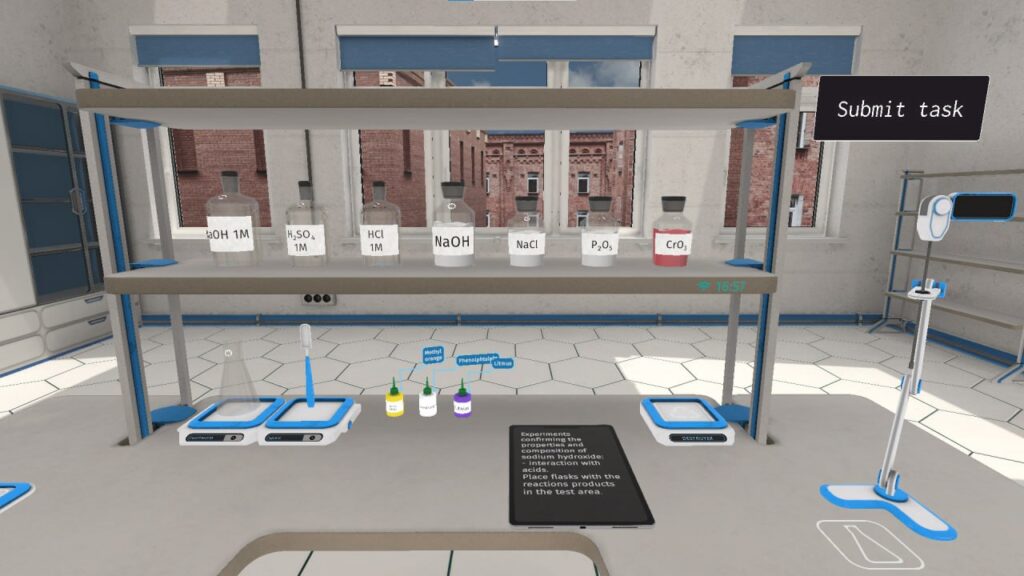
VIC’S SCIENCE STUDIO: chemistry lab in virtual reality
    • Full Immersion: Students conduct experiments in a digital classroom, handling virtual acids, bases, and salts with realistic precision.

    • Unlimited Freedom: Thanks to a robust chemical-physical model, each reaction unfolds just like the real thing—except now it’s 100% safe.

    • Teacher-Ready: Instructors access a library of tasks via a web interface, customizing lessons to fit different proficiency levels or curricula needs.

Modification-of-Crystal-Structures

MODIFICATION OF CRYSTAL STRUCTURES
    • Atomic-Level Insight: Users experiment with atoms themselves, tweaking color, size, and arrangement to see how structures react in real-time.

    • Hands-On Learning: This lab fosters deeper comprehension of chemical bonds and symmetry, concepts often difficult to convey through textbooks alone.

    • Endless Creativity: Students can imagine, build, and break down their own crystal lattices within the rules of chemistry.

Study-of-Crystal-Structures

    • Advanced Exploration: Pupils learn about the Poscar data type, an international standard for storing structural information.

    • 360-Degree View: See complex lattice configurations—like salt or apatites—from any angle, enhancing retention and enthusiasm.

    • Adaptable Complexity: From high-school STEM labs to university-level courses, this lab supports a wide range of academic requirements.

The Perks of VR Chemistry for Education

1. Safety First

When students explore experiments virtually, they eliminate risks tied to toxic chemicals or explosive reactions. Teachers can assign problem-based learning tasks without worrying about real-world hazards.

2. Resource Access

Whether a school lacks advanced apparatus or simply needs a way to engage learners remotely, VR solutions for schools offer unmatched convenience. Plus, content updates expand the range of experiments over time.

3. Interdisciplinary Learning

Chemistry often works hand-in-hand with biology and physics. Using a VR platform, teachers can blend these subjects seamlessly, enabling students to see how scientific principles intersect. This interconnected approach deepens understanding and sparks ongoing curiosity.

4. Engaging Digital-Classroom Experience

Teens are digital natives, excited by gamified lessons and immersive visuals. By investing in learning with VR, educators reduce distractions and push students to investigate topics more deeply.

Taking STEM to the Next Level—Even Without the Demo

While VR chemistry isn’t currently featured in XReady Lab’s free kit, pairing it with VR biology or VR physics can still invigorate daily lessons. These labs help break the monotony of lectures, offering an interactive-classroom environment where students conduct real investigations—no protective gear needed.

To see the transformational impact on your STEM curriculum, request a free demo. Experience how a single VR classroom setup can ignite curiosity, reinforce theoretical concepts, and nurture a genuine love for scientific inquiry.

Final Thoughts

Gone are the days when complex experiments belonged solely to advanced university labs. With VR technology in education, teachers can finally provide a fully immersive, hands-on environment where students learn through guided discovery. Whether it’s exploring new crystal configurations or safely handling volatile compounds, digital solutions open doors once locked by cost or practicality.

For any school dedicated to delivering top-tier science lessons, combining innovative chemistry resources with VR learning is the ultimate strategy. The result? Empowered students, happier teachers, and a dynamic STEM program ready to meet the challenges of modern-day academics.
04 / 08 / 2025

You may like it

Frequently Asked

Your questions, Answered!

How large is the library of XReady Lab content in VR, Web, and PC formats?

XReady Lab offers the largest K–12 STEM VR and Web/PC library with an AI Tutor. The packages include biology, physics, chemistry, and math, covering topics from primary school through high school.


All content is designed to align with major curricula and deliver engaging, interactive learning experiences. New simulations are added monthly.

Which curriculum alignment do you have?

XReady Lab’s simulations are aligned with IB, Cambridge IGCSE, AS & A Levels, NGSS, College Board, Common Core, TEKS, CBSE, BNCC, the National Curriculum for England, the Italian secondary school curriculum (Scuola Secondaria), and the National Curriculum of the Netherlands (VMBO, HAVO, VWO).

What are Career Packs, and which careers do they cover?

Career Packs are VR simulation bundles that let students explore STEM careers in practice. Current packs include: Future Doctor, Future Nurse, Future Engineer, Future HVAC Engineer, Future Biotechnologist, Future Astronomer, Future Neuroscientist.


New Career Packs are added regularly.

What makes XReady Lab’s AI Tutor different from other AI tutors and AI tools?

XReady Lab Superhuman AI Tutor works like a real tutor, guiding students step by step instead of giving ready-made answers. It focuses on reasoning, problem-solving, and explaining mistakes to build real understanding.

Created by international STEM Olympiad winners and coaches, it helps prepare for exams, increases memory retention by 40%, and works in real time in both VR and desktop formats with an internet connection.

What are Lesson Plans, Engagement Playbooks, and classroom scenarios?

XReady Lab packages include complimentary teacher training and ready-to-use Lesson Plans and Engagement Playbooks to support engaging lessons.

They guide teachers in integrating VR/web/PC simulations with clear objectives, step-by-step instructions, classroom management strategies, reflection activities, assessments, and technical checklists — helping teachers run effective lessons beyond the simulations themselves.

How to try XReady Lab for free?

Simply fill out the free demo form here to get access to demo XReady Lab simulations.

How do we plan and purchase a VR classroom?

We start with consultation: our team helps plan the VR classroom for your school. You need internet access and a suitable room — allocate about 5 x 5 feet (1.5 x 1.5 m) per student. One headset per two students works well.

Devices and licenses: schools can use existing Meta Quest or Pico devices and purchase licenses, or we can offer discounted devices or a turnkey solution with pre-installed content.

What happens after purchasing a VR classroom?

After purchase, we guide device setup and content installation and provide teacher training.

Teachers learn how to run VR lessons using Lesson Plans and Engagement Playbooks, manage screen casting and paired learning, and keep students engaged.

Ongoing support is always available.

What technical requirements and internet access are needed?

  • For Desktop or Tablet: Simulations run directly from the personal account and work without internet. If you want the AI Tutor in real time, a stable internet connection is required.
  • For VR headsets (Meta Quest or Pico): Internet is needed only to activate licenses. After activation, simulations work autonomously offline. To use the AI Tutor in real time, internet is required. Make sure your room has power outlets to recharge devices.

VR lessons: duration, class size, screen casting and teacher tools?

VR lessons typically last 5–15 minutes, depending on the simulation, with a recommended class size of up to 20 students. Screen casting is supported and compatible with selected teacher management systems, allowing teachers to launch simulations remotely, monitor progress, and view all devices during lessons.

Teachers are supported with Lesson Plans and Engagement Playbooks that include learning objectives, step-by-step lesson flow, classroom scenarios, reflection questions, practical assignments, and assessment guidance.

In which countries and languages is XReady Lab offered?

XReady Lab is available worldwide and supports 75+ languages. Today, it is used by 800+ schools and 150,000+ students across the globe.

What licensing and pricing options are available?

XReady Lab simulations are offered through flexible licensing packages, depending on the format and subjects you need:

  • VR simulation packages with AI Tutor: simulations are sold in subject-based bundles with an annual license per device. VR Biology + Physics + Chemistry: $975 per year per device.
  • Web version with AI Tutor for home or classroom use without VR headsets: $9.99 per month per user.

If you already have VR headsets, you only purchase licenses. If not, we can also help you choose the most cost-effective setup and licensing model for your school or family.

Which VR headsets are supported?

XReady Lab works with the most widely used standalone VR headsets in schools:

  • Meta Quest: Quest 2, Quest Pro, Quest 3, Quest 3S
  • PICO: Neo 3, Neo 3 Pro, Neo 4, Neo 4 Enterprise

All supported devices are standalone (no PC required), making them easy to deploy and manage in a school environment.

Does XReady Lab allow third-party VR content?

Yes. XReady Lab supports open ecosystems, not closed platforms. Schools can freely use third-party VR content alongside XReady Lab on Meta Quest and PICO headsets.

We encourage schools to diversify their VR classrooms with high-quality educational apps and can recommend tested solutions, helping expand learning beyond STEM into subjects like design, history, environmental studies, and soft skills.

What are the safety guidelines for VR?

XReady Lab follows school VR safety best practices. VR is recommended for students 10–12+, with short 5–15 minute sessions and seated or safe-zone use under teacher supervision, supported by screen casting.

First-time users adapt gradually. Students with medical conditions require parental and school approval, and hygiene is ensured through regular headset cleaning and replaceable face covers.

For families: What home-use options are available?

Families can access XReady Lab simulations at home in two ways:

  • Web version: Here, families can use simulations on computers or tablets with a subscription—no VR headset required.
  • VR home use: To get started, fill out the form and select the role “Parent” to receive a free demo. Our team will then contact you to discuss access and purchase options.